September 8, 2026 • Maren Solley • 9 min reading time • Prices verified June 12, 2026
Travel Toiletry Bags That Hang, Compress, and Survive a Six-Month Trip
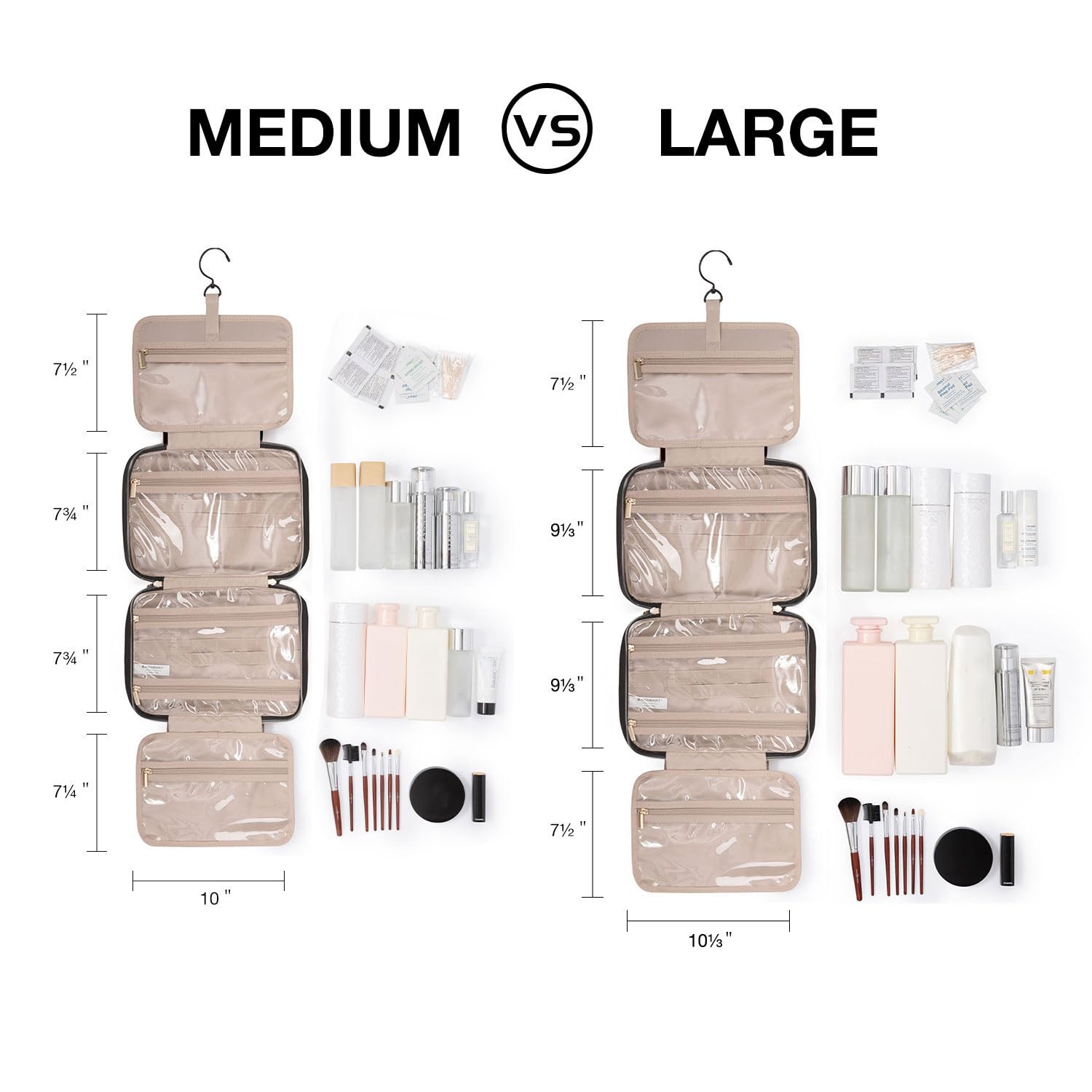
A toiletry bag is simply the pouch or organizer you use to carry personal-care products — shampoo, skincare, medications, razors — when you travel. On a weekend trip, almost anything works. But once you’re packing for two weeks in Southeast Asia, a month-long work rotation, or a six-month overland circuit, the cheap zip pouch you grabbed at the airport starts to fail you in very specific, very annoying ways: bottles leak onto clothes, the bag won’t stand up on a tiny hostel sink shelf, and you spend ten minutes excavating it every morning for your moisturizer. A good travel toiletry organizer solves those problems by adding structure, a hanging hook so it works on any bathroom door or towel rail, and materials that shrug off moisture and rough handling.
This guide compares the formats, features, and trade-offs across the category — from compact sub-liter pouches that slip into a personal item to full hanging organizers sized for a four-month kit. If you’re currently deciding between a few shortlisted options or trying to figure out which format fits your system, this is designed to hand you a clear decision framework, not just a ranked list.
| EDITOR'S PICKBAGSMART Travel Toiletry Bag | Mid-tierBAGSMART Toiletry Bag Travel Ba… | Budget pickVorspack Travel Toiletry Bag fo… | |
|---|---|---|---|
| Hanging hook | — | ✓ | ✓ |
| Water-resistant | — | ✓ | ✓ |
| Handle | ✓ | — | — |
| Wide-open design | ✓ | — | — |
| Size | — | Medium | Medium |
| Full-size bottles | — | ✓ | — |
| Price | $23.99 | $14.99 | $9.99 |
| See on Amazon → | See on Amazon → | See on Amazon → |
The Four Formats and What Each One Actually Solves
Before naming specific bags, it’s worth mapping the format landscape — because choosing the wrong shape costs you either space or usability, and most buyers don’t realize this until they’re mid-trip.
Flat zip pouch. The simplest format: a rectangular zippered bag, usually 1–2 liters of capacity, no internal structure. It packs flat, weighs almost nothing, and costs almost nothing. The trade-off is that it doesn’t hang, it doesn’t stand up, and finding anything inside requires dumping the contents on the counter. Serviceable for weekend trips or as a secondary pouch inside a larger organizer. Reviewers at Condé Nast Traveler note flat pouches work well as overflow containers when your main organizer runs out of room.
Hanging dopp kit / roll-up organizer. The workhorse format. These unfold or unzip to reveal multiple internal pockets — typically a main zippered compartment, elastic loops or slots for smaller items, and a clear inner pocket for liquids. A built-in hook (usually a carabiner-style clip or stiff fabric loop) lets the whole bag hang from a towel bar, shower rod, or door hook at eye level, so your full kit is visible and accessible without touching a potentially dirty counter. Capacity typically runs 2–4 liters. This is what most experienced travelers settle on. REI’s buying guide for toiletry bags identifies the hanging format as the most versatile for trips lasting more than a few days.
Compressible / packable organizer. Bags in this format prioritize packability over structure — they’re made from ultralight ripstop or tightly woven nylon and compress down to near-nothing when empty. Some weigh under 50 grams. The trade-off: thinner materials are more vulnerable to puncture from a stray razor or nail scissors, and internal organization is usually minimal. Best for ultralight backpackers or travelers who keep a very small kit.
Hard-shell or semi-rigid case. Think of a small clamshell container with a zipper around the perimeter. Hard cases protect fragile bottles and glass containers well, and they stand up on any surface. The cost is weight and bulk — these don’t compress at all. Wirecutter’s coverage of toiletry bags notes that hard-shell cases tend to appeal most to travelers with expensive skincare products or glass dropper bottles they can’t afford to break.
The Features That Actually Matter After Month One
Once you’ve chosen a format, the spec differences between bags become real differentiators on long trips. Here’s where to spend your attention:
Hook quality. A flimsy plastic clip that snaps under the weight of a fully loaded bag — roughly 0.5–1 kg — is a known failure point across the category. Owners of budget hanging bags consistently report this as the first thing to break. Look for a metal carabiner-style clip or a reinforced fabric loop with a metal grommet. The Osprey Ultralight Roll Organizer (spec-rated at a 1.5 kg load limit on its hook, per manufacturer specs) and the Eagle Creek Pack-It Reveal Hanging Toiletry Kit are both owners-recommended for hook durability in long-run reviews aggregated across major retail platforms.
Water resistance vs. waterproofing. Most bags at this price point use water-resistant coatings (DWR — durable water repellent) on the exterior fabric, not waterproof construction. The distinction matters: water-resistant means light splash protection; waterproof means you can rinse the bag under a tap. For a six-month trip where a shampoo bottle will eventually leak, interior lining is the feature to prioritize — specifically, a TPU (thermoplastic polyurethane) or coated nylon interior that can be wiped clean or rinsed out. AFAR’s guide to toiletry bags flags interior lining quality as one of the most overlooked features shoppers skip over.
Bottle containment and leak isolation. A dedicated interior wet pocket — usually a clear zipper pouch that separates liquids from dry items — is worth its weight. Even with TSA 3-1-1 rules relaxed for checked luggage, liquids leak, and containing the damage to a single pocket that can be unzipped and rinsed out is a meaningful quality-of-life feature on a long trip.
Total volume and internal layout. Volume alone is a poor guide because internal organization affects usable capacity. A 3-liter bag with one large cavern and no dividers is less functionally useful than a 2.5-liter bag with elastic loops, a flat pocket, and a clear wet pouch. Sketch out your actual kit contents before you buy — most travelers carrying a 3–4 week kit need approximately 2.5–3.5 liters of organized capacity; a six-month expedition kit may push 4–5 liters once medications and backup items are included.
By the Numbers
| Format | Typical Weight | Typical Capacity | Hook Included | Best For |
|---|---|---|---|---|
| Flat zip pouch | 30–80 g | 0.5–1.5 L | No | Weekend trips, overflow |
| Hanging organizer | 120–300 g | 2–5 L | Yes | 1-week to 6-month trips |
| Compressible/ultralight | 30–90 g | 1–3 L | Sometimes | Ultralight, minimal kit |
| Hard-shell case | 300–600 g | 1–3 L | No | Fragile items, glass bottles |
Three Bags Worth Knowing in 2026
These are not the only options worth considering, but they represent three distinct positions in the market — and understanding why each exists sharpens the decision for your specific situation.
Osprey Ultralight Roll Organizer (~$45). Osprey’s entry into this category leans hard into the compressibility angle without fully sacrificing organization. Reviewers consistently praise the roll-top closure and the fact that it packs down to roughly the size of a thick paperback when empty. The hook is metal and owners report it holding up well under load. The trade-off: interior organization is simpler than competitors at this price — there are fewer elastic loops, and the wet pocket is not separated. For ultralight travelers or those whose kit runs small, this is the logical pick. For a six-month kit with medications, full-size skincare, and backup items, it will feel cramped.
Eagle Creek Pack-It Reveal Hanging Toiletry Kit (~$55). Eagle Creek’s Pack-It line is built around the idea of a full luggage organization system, and this bag reflects that philosophy: multiple zippered compartments, a dedicated clear wet pocket, and a structured exterior that stands upright on a counter when unhooked. The Reveal version uses semi-transparent fabric panels that let you see contents without unzipping — a genuinely useful feature at 6 a.m. in a shared hostel bathroom. Capacity runs around 3.5 liters. Long-run reviewers note the zippers hold up through sustained use. This is the bag Wirecutter’s coverage of the category most consistently returns to as a benchmark.
Aer Travel Kit 2 (~$65). Aer’s design language skews toward the digital nomad and business travel audience — clean external lines, a matte ballistic nylon exterior, and internal organization clearly designed by someone who’s actually packed a three-week kit. The main compartment lays flat when open, the elastic loops accommodate a full-size product lineup, and the integrated mirror is genuinely useful. The hook is a stiff loop rather than a carabiner clip — functional, though some owners report it as less versatile on thin towel rails. At $65, it sits at the higher end of the hanging organizer category, and the quality-to-price ratio earns broadly positive marks from reviewers at AFAR and CN Traveler alike.
The Decision Framework: If X, Then Y
This is the matrix that should resolve most pending purchase decisions:
If your trips run under two weeks and your kit is minimal: A sub-$30 flat pouch or the Osprey Ultralight Roll Organizer is sufficient. Don’t over-invest here.
If you’re taking trips of 2–8 weeks and staying in a mix of hotels and shared bathrooms: The Eagle Creek Pack-It Reveal Hanging Kit is the pragmatic anchor pick. The hanging functionality earns its keep in shared facilities, and the wet-pocket isolation will pay for itself the first time a bottle leaks.
If you’re a frequent business traveler or digital nomad maintaining a full skincare and grooming routine across 30+ nights per year: The Aer Travel Kit 2’s organizational layout and durable exterior justify the price premium. Owners report it holds its appearance and functionality across multi-year use, which recasts the cost-per-use math favorably.
If you’re building a six-month expedition kit that includes medications, supplements, or backup products: Consider a two-bag system: a primary 3.5–4 liter hanging organizer (Eagle Creek or Aer) for daily-use items plus a secondary flat pouch or compression sack for backup and bulk items that stay in your main pack until needed. REI’s packing guides for long-haul travel consistently recommend separating “daily access” from “infrequent access” items as a core organizational principle — and toiletries are no exception.
If you carry glass bottles or fragile product containers: A semi-rigid or hard-shell case is worth the weight penalty. No soft organizer, regardless of price, protects glass from a dropped pack the way a structured shell does.
The one trade-off to keep in mind regardless of which path you choose: hook quality and interior lining are the two features most correlated with long-trip satisfaction in owner reviews, and both are frequently the features where budget options cut corners first. Spend your money there before spending it on volume or external aesthetics.