August 24, 2026 • Maren Solley • 9 min reading time • Prices verified June 12, 2026
Sling Bags and Crossbody Daypacks for City Travel: Security, Size, and Sanity
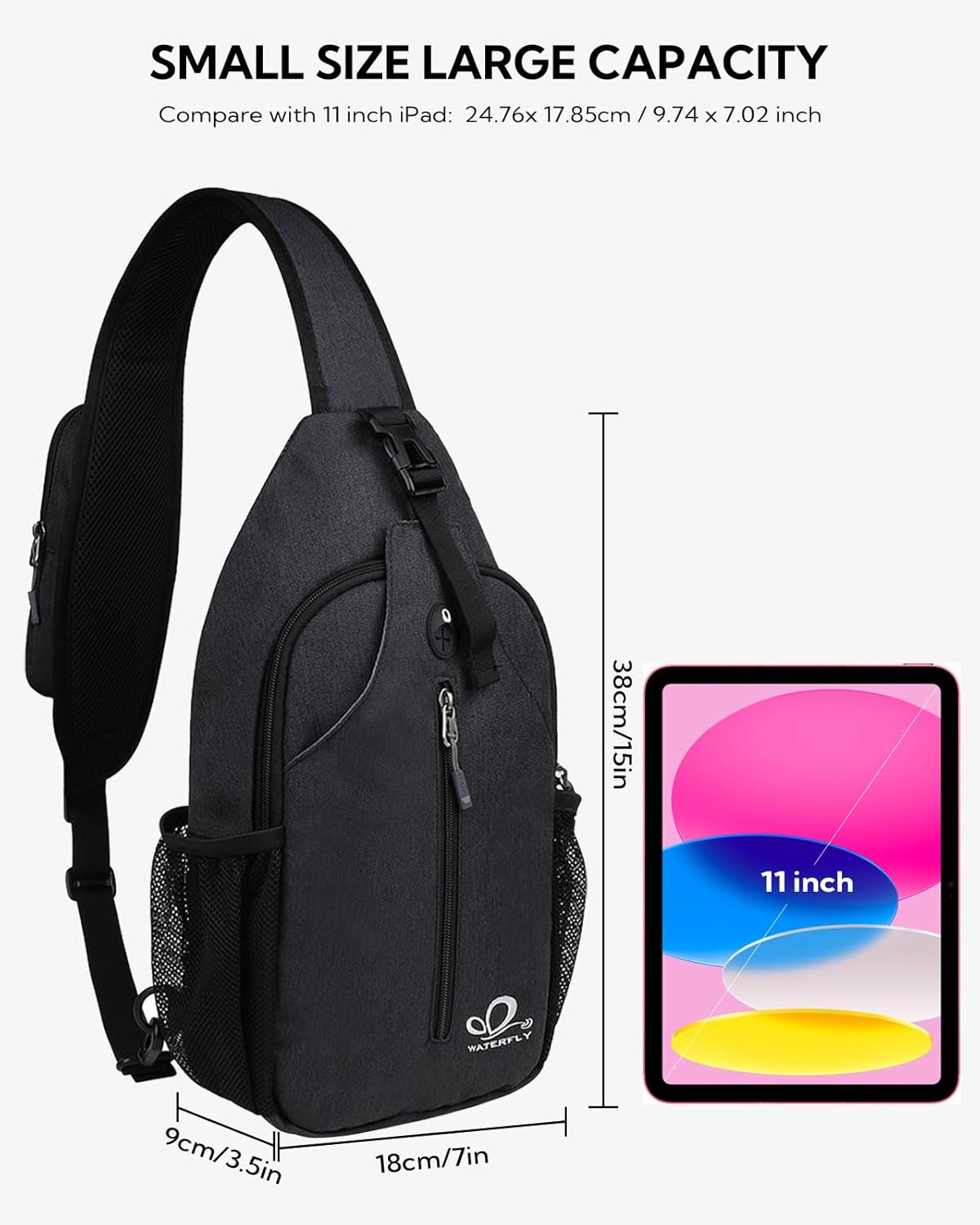
A sling bag is exactly what it sounds like: a single-strap bag worn diagonally across the body, usually sitting against your hip or lower back. A crossbody daypack is a close cousin — also worn on one shoulder, but typically larger (think 8–20 liters of capacity, or roughly enough for a jacket, water bottle, and a day’s worth of gear) and shaped more like a compressed backpack than a flat pouch. Both styles occupy the same general space in your kit: too small to be your main luggage, too purposeful to be a purse or hip pack. They exist to carry your city-day essentials — wallet, phone, camera, snacks, transit card — while keeping your hands free and your valuables reasonably secure. If you’ve been defaulting to a drawstring tote or a full 30-liter backpack for city days and wondering whether there’s a smarter middle path, this guide is for you.
Below, we’ll walk through how to size the decision, what security features actually matter versus which are marketing theater, and which specific bags are worth serious consideration in 2026 — across a range from under $60 to over $200.
Sling vs. Crossbody Daypack: The Core Tradeoff
The naming here is slippery and brands use the terms interchangeably, so let’s define the functional divide rather than the vocabulary one.
Compact sling (roughly 3–6L): Think of a sling in this range as a wallet that grew up. The peak design is something like the Peak Design Sling 5L or the Aer City Sling 2 — flat profiles, quick-access organization, and a footprint small enough that you can swing it to your front on a crowded metro without disrupting anyone. The tradeoff is that you’re working with a constrained volume. A 1-liter water bottle, a folded rain shell, and a paperback probably fills it. Laptops are out. These are optimal for: city walking days where your hotel or Airbnb is holding your main bag, theme parks, museum marathons, and transit-heavy itineraries where you need to board quickly.
Larger crossbody daypack (roughly 10–20L): This category blurs into “small backpack worn sideways,” which is accurate. Bags like the Osprey Daylite Sling (6L), the Patagonia Atom Sling (8L), or the Bellroy Venture Sling (10L) can carry a hydration reservoir, a packable layer, and a small mirrorless camera without much drama. Some in the 16–20L range — like the Tom Bihn Aeronaut Shoulder Bag — function as a legitimate secondary travel bag capable of being a personal item on most airlines when packed thoughtfully. The tradeoff here is bulk and swing: a 15L crossbody on a crowded tuk-tuk is a social event.
The decision rule: If your city days involve returning to a home base mid-day (hotel, coworking space, apartment), go smaller — a 5–8L sling is almost always the right answer. If you’re doing full-day self-sufficient touring — water, snacks, a layer, a guidebook or small tech kit — size up to 10–16L and consider whether a small backpack might just be more comfortable for that specific day.
Security Features: Real vs. Theater
Smarter Travel’s guide on avoiding pickpockets notes that the single most effective deterrent isn’t a locked zipper or slash-resistant fabric — it’s awareness and bag positioning. That said, certain design features do meaningfully reduce your exposure in high-density environments like Barcelona’s La Rambla, Bangkok’s Chatuchak market, or Rome’s metro.
Features that actually matter:
-
Zipper placement on the body-facing side. This is the single biggest structural security feature. A bag that opens against your body (rather than facing outward) forces any would-be pickpocket to navigate around you. The Patagonia Atom Sling and the Peak Design Sling 5L both do this well by design. Conde Nast Traveler’s 2025 sling bag roundup flags rear-zipper access as a key criterion in their security scoring.
-
Lockable zipper pulls. A small TSA-compatible lock or a zipper pull that can be clipped to a D-ring is a friction deterrent, not a hard barrier. It buys you time — and in most theft scenarios, time is the whole game.
-
Low-profile hardware. Bright branding, flashy clips, and chrome hardware signal “tourist with gear.” Matte hardware and unbranded fabric (or understated logos) genuinely reduce your signal. Brands like Aer and Tom Bihn tend toward restraint here.
Features that are mostly theater:
-
“Cut-resistant” fabric panels. Outside Online notes in their sling bag reviews that slash-resistant materials are a real technology but are almost never deployed against city bags in practice — documented bag-slashing is far rarer than simple grab-and-run or unzipped-pocket theft. It’s a useful upside, not a primary buying criterion.
-
RFID-blocking pockets. The RFID skimming threat is real but narrow: it applies specifically to older contactless credit cards and some passport chips. Modern EMV credit cards (chip-and-pin) and phones with NFC require active authentication. REI Co-op’s daypacks buying guide acknowledges RFID pockets as a reasonable inclusion but notes they shouldn’t be a primary purchase driver.
Positioning is the multiplier. Swing the bag to your front in crowds, keep one hand on it when seated at outdoor cafes, and don’t leave it hanging off a chair back. That behavioral discipline outweighs any materials science.
Sizing the Investment: What You Should Expect to Pay
| Price tier | What you get | Representative options |
|---|---|---|
| Under $60 | Functional construction, limited organization, shorter lifespan | Amazon Basics sling, generic crossbody |
| $60–$120 | Quality zippers (YKK), decent fabric, reliable organization | Patagonia Atom Sling 8L ( |
| $120–$200 | Premium materials, thoughtful layout, strong warranty | Peak Design Sling 5L ( |
| $200+ | Lifetime warranty territory, custom hardware, curated design | Tom Bihn Synapse Shoulder Bag ( |
A note on these price points in a mid-2026 context: tariff adjustments on goods manufactured in Southeast Asia have pushed several popular bag prices up 10–20% over the past 18 months. Patagonia’s Atom Sling, historically around $79, now retails at approximately $89 MSRP. Budget accordingly, and check brand-direct pricing versus third-party retailers — the gap has widened.
The Bags Worth Considering
These aren’t ranked — they address different use cases. Match the bag to your actual itinerary, not to a generic “best of” ranking.
Peak Design Sling 5L (~$89.95): Reviewers across aggregated sources consistently cite the external capture clip system and the MagSafe-compatible internal layout as genuine differentiators, not marketing. The weatherproofed canvas exterior holds up well in light rain, per owner reports. Best for: travelers who also shoot with Peak Design camera gear, or anyone who values one-handed access without unslinging the bag.
Aer City Sling 2 (~$89): AFAR’s travel bag coverage notes the Aer City Sling 2 as one of the cleaner executions of the minimal-profile sling for urban environments. The luggage-grade zipper and internal organization (separate tech pocket, pen loops, slim wallet sleeve) are above average for the price. Best for: business-casual city travelers who want the bag to look intentional in a coworking space or client meeting.
Patagonia Atom Sling 8L (~$89): The Atom Sling punches above its price category on durability — Patagonia’s Ironclad Guarantee covers defects indefinitely, and owners consistently report 5–7 year lifespans under regular use. The 8L volume is the sweet spot for full-day touring without a home-base stop. Best for: travelers doing long walking days who need a rain layer and water bottle to come along.
Osprey Daylite Sling 6L (~$75): REI Co-op’s daypack guide highlights Osprey’s All Mighty Guarantee (lifetime warranty on defects) as a strong value multiplier in this price range. The Daylite Sling is lighter than the Atom and has a more breathable back panel — relevant in humid destinations. Best for: warm-weather city travel, travelers who run hot, and REI members who can stack member rewards on the purchase.
Bellroy Venture Sling 10L (~$169): Bellroy’s build quality is consistently noted in reviews as “quietly premium” — the materials feel more expensive than the price suggests, which is the right kind of surprise. At 10L, this sits at the upper edge of the crossbody category and functions as a genuine personal-item daypack for carry-on-only travelers. Best for: digital nomads doing city days who need laptop-adjacent capacity without a full backpack.
Tom Bihn Synapse Shoulder Bag (from ~$190): Made in Seattle, lifetime warranty, and a fervent owner community that documents multi-year use across dozens of countries. Tom Bihn’s products don’t get wide retail distribution, so most buyers go direct. The organizational depth here is unusual — this bag has more discrete pockets than most daypacks twice its size. Best for: frequent travelers who want to buy once and carry forever, and who don’t mind a slightly utilitarian aesthetic.
The Decision Framework
If you’re staring at your trip itinerary trying to decide which direction to go, work through this:
If your days are hotel-based with mid-day returns: Buy the 5–6L sling. You don’t need more volume than that, and the smaller profile is genuinely more comfortable and less conspicuous in dense city environments. The Peak Design Sling 5L and Aer City Sling 2 are the right shortlist.
If you’re doing full-day independent touring with no home-base stop: Size up to 8–10L. The Patagonia Atom Sling 8L or Bellroy Venture Sling 10L give you enough room for real-world day-carry without becoming unwieldy. Don’t go above 10L in crossbody configuration — anything larger is genuinely more comfortable as a backpack.
If you’re a digital nomad or location-independent traveler moving between cities: The Bellroy Venture or Tom Bihn Synapse Shoulder Bag are the serious candidates. You need organizational depth for tech, you’re probably sitting at café tables and coworking spaces where a bag on your back is awkward, and you’ll carry this bag 250+ days a year — the per-use math on a $170–$200 purchase is convincing.
If budget is the binding constraint: The Osprey Daylite Sling at $75 with a lifetime warranty is the honest best value in the category. Don’t let a tight travel budget push you toward a $25 generic that fails at the zipper after three trips.
One final note: the best sling bag is the one you actually use consistently instead of reverting to a drawstring tote. Fit matters more than features. If a bag’s strap system or swing point doesn’t feel natural after five minutes in a store (or during a generous return window), no amount of clever pockets will make you reach for it on a travel day.