October 25, 2026 • Maren Solley • 11 min reading time • Prices verified June 12, 2026
The Sling Bag for Long Trips: Waterfly and Travelon Compared for Daypack, Airport, and Anti-Theft Use
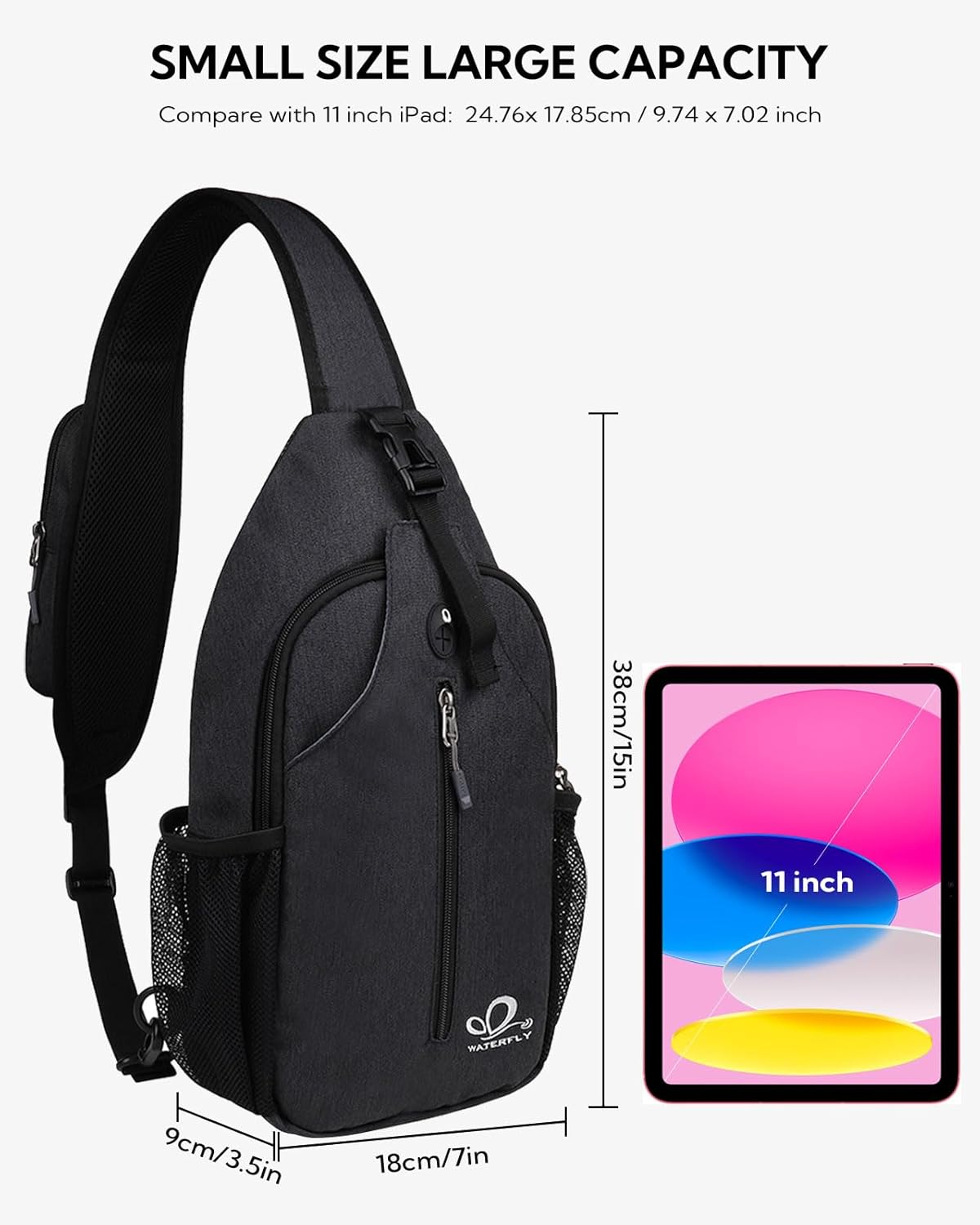
A sling bag — a single-strap bag worn diagonally across the body, either chest-forward or draped over one shoulder — occupies a useful middle ground between a bulky daypack and a wallet. For travelers, it’s the bag you reach for when your main luggage is at the hotel and you’re heading into a crowded market, a theme park, or a long airport connection. Two names come up constantly in this category at the accessible end of the market: the Waterfly sling and the Travelon anti-theft crossbody bag. They solve slightly different problems and attract noticeably different buyers — and understanding that difference before you commit will save you from owning the wrong one. This piece draws on aggregated owner reviews, published spec comparisons, and editorial coverage from sources including Condé Nast Traveler and AFAR to lay out exactly who should buy which.
If you already know you want a sling and you’re just deciding between these two, skip to the decision section. If you’re still orienting — keep reading.
| EDITOR'S PICKTravelon Anti-Theft Classic Mes… | Budget pickWATERFLY Crossbody Sling Backpa… | |
|---|---|---|
| Anti-theft | ✓ | — |
| Dimensions | 9" x 12.5" x 3.5" | — |
| Center height | 9.5" | — |
| Carry type | Messenger | Sling / crossbody |
| Size | — | Small |
| Price | $55.99 | $24.99 |
| See on Amazon → | See on Amazon → |
What Each Bag Is Actually Trying to Do
These bags start from different design briefs, and that matters more than any spec comparison.
The Waterfly sling is a general-purpose carry-everywhere bag engineered around convenience and capacity. Its design priority is fast access — particularly the strap-mounted phone pocket, which sits on the shoulder strap itself so you can pull your phone without opening the main compartment. Owners across aggregated reviews describe it as the bag they default to for daily walks, theme park days, and electronics-heavy city touring. One frequently cited example: a reviewer who used it as a dedicated electronics daypack across a three-year Ireland trip and subsequently bought a second unit — not because the first failed, but because it worked so well they wanted the same system duplicated. That kind of repeat-purchase behavior is a more reliable endorsement than any single five-star rating.
The Travelon anti-theft crossbody starts from a security brief. Its headline features — slash-resistant strap, locking zipper pulls, RFID-blocking card slots — are designed to neutralize the most common opportunistic theft methods in busy tourist environments. Smarter Travel, in their guide “How to Avoid Pickpockets Abroad,” notes that opportunistic theft in tourist environments typically targets easy access points: exposed pockets, unsecured zippers, and cuttable straps. Travelon’s design addresses all three. What’s honest to say here is that reviewers consistently describe the value as psychological: “one less thing to worry about” is the phrase pattern that recurs across accounts. AFAR, in their editorial piece “The Best Anti-Theft Travel Bags,” notes this dynamic across the category: the value is peace of mind in high-risk environments, not a documented incident log.
These aren’t competing for the same use case. The Waterfly is a better daily carry. The Travelon is a better security tool.
Specifications That Shape Real Packing Decisions
Before going deeper, here are the published specifications that govern what you can actually fit:
| Feature | Waterfly Sling | Travelon Crossbody |
|---|---|---|
| Capacity | ~6L (varies by colorway) | ~5L |
| Strap type | Padded, adjustable | Slash-resistant cable-core |
| RFID blocking | No | Yes (card slots) |
| Water resistance | Water-resistant outer | Water-resistant outer |
| Tablet fit | No dedicated sleeve | Up to 10” tablet (manufacturer-stated) |
| Strap phone pocket | Yes (dedicated) | No |
Capacity here means the total interior volume in liters — roughly how much gear you can fit. Six liters accommodates a water bottle, a light jacket, a battery pack, your passport, and a day’s worth of small items. It does not accommodate a 13-inch laptop. Neither bag is pretending to be a laptop bag, and neither should be evaluated as one.
Feature Breakdown: Where Each Bag Wins
Access and Organization
The Waterfly’s strap-mounted phone pocket is the feature owners return to most often, and it’s worth understanding why it resonates. In a crowded street or a theme park queue, reaching into your bag for your phone is a nuisance and a distraction — and it briefly requires you to hold the bag open in a public space. A strap-mounted pocket eliminates both problems. Your phone stays accessible without advertising the interior of your bag.
The practical question for 2026 buyers is whether this pocket fits current large-format phones. Aggregated reviews suggest it comfortably fits phones in the 6.1–6.4-inch size class. Current-generation large-screen phones at 6.7 inches and above may fit but can feel snug, particularly with a thick protective case. If your phone is a recent large-screen model, verify fit before committing; this is one case where dimensions in hand matter more than spec-sheet numbers.
The main compartment also earns consistent praise for practical organization — enough pockets to separate a battery pack, cables, sunscreen, and a travel wallet without everything consolidating into one chaotic interior. REI Co-op Learn Hub, in their article “How to Choose a Travel Daypack,” identifies interior organization as one of the primary differentiators among small carry bags, noting that pocket placement affects how quickly you can retrieve items in motion — exactly what the Waterfly’s layout addresses.
WATERFLY
$24.99
In stock on Amazon
Check price on AmazonSecurity Features
The Travelon’s slash-resistant strap deserves an honest assessment. The cable core runs inside the strap webbing and makes it meaningfully harder to cut the strap and run — a real technique used in high-tourist-density cities. Smarter Travel’s guide “How to Avoid Pickpockets Abroad” specifically identifies strap-cutting as a documented method in crowded transit environments; slash resistance addresses this directly. One reviewer documented keeping the Travelon’s contents dry through sustained rain — a rare, specific, and useful data point showing the bag’s water resistance held under real precipitation, not just light misting.
The locking zipper pulls — small carabiner-style locks that prevent a stranger from unzipping the bag without your noticing — are straightforward and effective. They add a few seconds to your own access, which is the honest tradeoff. For most daypack use, this cost is negligible. For situations where you’re frequently opening the bag at a market or café, it becomes slightly more noticeable.
RFID blocking, present in the Travelon’s card slots, prevents electronic skimming of chip-enabled cards and passports. Lonely Planet, in their editorial “Essential Gear for Independent Travel,” notes that RFID skimming risk is real but relatively low compared to physical pickpocketing — it’s a useful feature to have and rarely costs anything in convenience. Condé Nast Traveler, in “The Best Travel Bags for Every Kind of Trip,” notes that bags in this category perform adequately in incidental rain but shouldn’t be treated as a substitute for a waterproof dry bag.

Travelon
$55.99
In stock on Amazon
Check price on AmazonComfort Over Distance
The Waterfly’s padded strap makes extended transit carries more comfortable than the Travelon’s thinner cable-core strap, based on consistent reviewer accounts. For shorter carries — a city block, a market circuit, a boarding line — this difference is irrelevant. For multi-hour airport transit days between terminals, the padding difference becomes noticeable over time.
Both bags can be worn chest-forward or swung to the back. For airport queues and boarding lines, chest-forward carry is almost universally preferred by reviewers — it keeps the bag visible, accessible, and less likely to bump other passengers. For longer walking legs between terminals, back carry is more comfortable. If you anticipate carrying either bag for more than two hours continuously, the Waterfly’s padded strap is a meaningful advantage. If your carries are typically short and interrupted, this distinction rarely matters.
AFAR, in “The Best Anti-Theft Travel Bags,” notes that strap comfort over extended wear is one of the most commonly underweighted factors when buyers choose security-forward bags — the security features are front of mind at purchase, but the strap is what you feel for hours afterward.
Travelon
$55.99
In stock on Amazon
Check price on AmazonDurability: An Honest Gap in the Record
This is the section where the honest answer is “we don’t know well enough.”
No reviewer across either bag documents long-term strap wear, zipper failure rates, or hardware degradation over multiple years of heavy use in any systematic way. The Ireland trip reviewer mentioned above provides a three-year anecdote, which is encouraging for the Waterfly, but anecdote is not longitudinal data. For the Travelon, the cable-core strap’s long-term comfort under daily carry has not been systematically documented in available owner feedback.
What this means practically: if you’re buying either bag for a single extended trip or a seasonal use pattern, the durability picture is sufficient. If you’re considering either as a true daily carry for two or more years of heavy travel, you’re making a partially blind bet. The pricing on both bags is low enough that replacement cost is manageable — but that’s a workaround, not a solution. Buyers who need documented multi-year durability should look at higher-priced bags in this category, which have more extensive long-term owner records.
Airport and Security Checkpoints
Neither bag triggers unusual issues at airport security based on owner accounts. Both are small enough to pass as personal items under most airline policies — bags in the 5–8L range almost never receive gate scrutiny at standard boarding.
The Travelon’s metal carabiner zipper locks are the one element to watch: owners report no systematic issues at screening, but metal hardware runs through the X-ray belt alongside the bag and can occasionally prompt a secondary look if the image reads ambiguously. This is infrequent and easily resolved by keeping the locks visible rather than buried under the bag.
The more practical airport question is how you wear the bag during transit. The Waterfly’s padded strap makes long terminal walks notably more comfortable than the Travelon’s thinner cable-core strap. For short connecting flights, this difference is irrelevant. For large hub airports with extended terminal walks, it becomes a real quality-of-life factor over the course of a travel day.
Decision Frame: Which Bag for Which Traveler
This is the practitioner’s choice. Here’s the explicit decision matrix:
If your primary concern is day-to-day convenience and fast access — theme parks, city walking, electronics management — the Waterfly is the better buy. The strap phone pocket alone is worth the price of entry for high-access situations, and the organizational layout is thoughtfully designed for the use case. The repeat-purchase behavior documented in owner reviews is the strongest available signal.
WATERFLY
$24.99
In stock on Amazon
Check price on AmazonIf your primary concern is operating in high-theft-risk environments — crowded markets, busy transit hubs, destinations where bag-snatching is documented — the Travelon is the better buy. The slash-resistant strap and locking zippers provide measurable deterrence, and the psychological benefit of not monitoring your bag constantly is real value for travelers in unfamiliar or high-density environments. Accept that the convenience features are thinner.
Travelon
$55.99
In stock on Amazon
Check price on AmazonIf you’re deciding between the two for a single long trip that includes both city tourism and high-density risk environments, the case for Travelon is stronger because security features work in low-risk environments too — a bag with locking zippers functions fine on a low-risk day, while a bag without them leaves you exposed on a high-risk one. Convenience features can be substituted with habits; security features cannot.
Travelon
$55.99
In stock on Amazon
Check price on AmazonNeither bag is appropriate if you need to carry a 13-inch laptop daily. Both are sling bags, and sling bags are a daypack complement, not a daypack replacement.
Frequently Asked Questions
Does the Waterfly sling fit a current-generation large-screen smartphone in the strap pocket? Reviewers consistently confirm it fits phones in the 6.1–6.4-inch range comfortably. For larger current-generation models at 6.7 inches and above, fit becomes case-dependent — slim cases tend to work, thick protective cases may not. Verify dimensions before purchasing if you carry a large phone in a rugged case.
Can the Travelon anti-theft bag fit a 10-inch tablet? The manufacturer states compatibility with tablets up to 10 inches, which aligns with owner accounts. A standard 10-inch tablet fits; it will occupy the majority of the main compartment, leaving limited room for other items. A 10-inch tablet with a keyboard folio case may not fit.
How does the Waterfly hold up after two or more years of daily use? Honestly: long-term durability is not well-documented in available owner feedback. The three-year Ireland trip anecdote is encouraging, but it represents a single data point rather than a documented pattern. Treat multi-year durability as an open question for either bag.
Is the Travelon’s slash-resistant strap noticeably heavier or less comfortable than a standard strap? Reviewers do not describe the cable core as noticeably heavy, but do note the strap is thinner and less padded than the Waterfly’s. For shorter carries, this is irrelevant. For multi-hour airport transit days, the padding difference becomes more noticeable.
Which bag works better worn across the chest versus on the back? Both bags are designed for cross-body wear and function in either orientation. Chest carry is preferred for security and access; back carry is preferred for extended walking comfort. The Waterfly’s padded strap makes back carry more comfortable over longer distances.
Do either of these bags cause issues at airport security screening? Owner accounts do not document systematic issues with either bag. The Travelon’s metal carabiner zipper locks are the most likely element to attract a secondary X-ray look, but this is infrequent and easily resolved by keeping the hardware visible on the belt.