July 26, 2026 • Maren Solley • 12 min reading time • Prices verified June 12, 2026
The Personal Item Backpack Upgrade: When a $30 Bag Beats a $200 One
Most airlines allow you to bring two bags onto the plane: one larger carry-on that goes in the overhead bin, and one smaller “personal item” — a bag that must fit under the seat in front of you. That under-seat slot is roughly 18 × 14 × 8 inches on most major carriers, though it varies by aircraft and airline, and it’s genuinely useful space. A well-chosen personal item backpack can hold a laptop, a day’s worth of clothes, snacks, your travel documents, and everything else you’d hate to check. The problem is that the market for these bags runs from $25 Amazon specials to $200 specialist packs — and the right answer isn’t always to spend more. This piece breaks down exactly where the value curve bends, which specific bags have earned real owner trust, and what to look for if you’re currently deciding.
If you’re mid-research — you’ve watched the YouTube comparisons, you’ve got a browser tab open for at least one $150+ bag, and you’re wondering whether you’re about to overspend — this is written for you.
The Value Curve: Where Budget Bags Win and Where They Don’t
Let’s start with an honest framing. The gap between a $30 personal item backpack and a $150 one is real, but it is not uniformly distributed across every feature. Some premium features genuinely justify the price jump. Others are margin dressing.
Where budget bags hold their own:
- Raw volume. A $35 bag can hit 40L just as easily as a $180 one.
- Airline compliance. Size is size — a bag that fits the under-seat gauge does so regardless of price.
- Basic organization. Zippered pockets cost almost nothing to manufacture.
Where premium bags earn the price:
- Frame and structure. A well-built back panel with load-bearing suspension makes a real difference when you’re carrying 20 lbs through an airport for four hours.
- Luggage pass-through. A dedicated sleeve that slides over a rolling suitcase handle is a feature budget bags rarely execute well.
- Long-term durability. Owners of premium bags consistently cite 3–5 years of daily carry with no seam failures. Budget bags tend to show mixed signals in review aggregates after the 12-month mark.
- Harness quality. Padded shoulder straps and a sternum clip matter more on a 40L loaded bag than on a 20L gym tote.
The practical decision rule: if this is your only bag for a weekend trip or your under-seat overflow on an infrequent flight, a well-reviewed budget bag is a legitimate choice. If you’re a frequent flyer who treats the personal item slot as a working system — laptop out at security, documents accessible at the gate, daypack for the destination — the case for premium strengthens considerably.
The Bags Worth Knowing
The five bags below represent distinct positions on the price-to-feature spectrum. Each H3 section ends with a tier marker so you can scan quickly to the category that matches your travel frequency and budget.
ECOHUB: The Bag That Won by Default — and Then Won on Merit
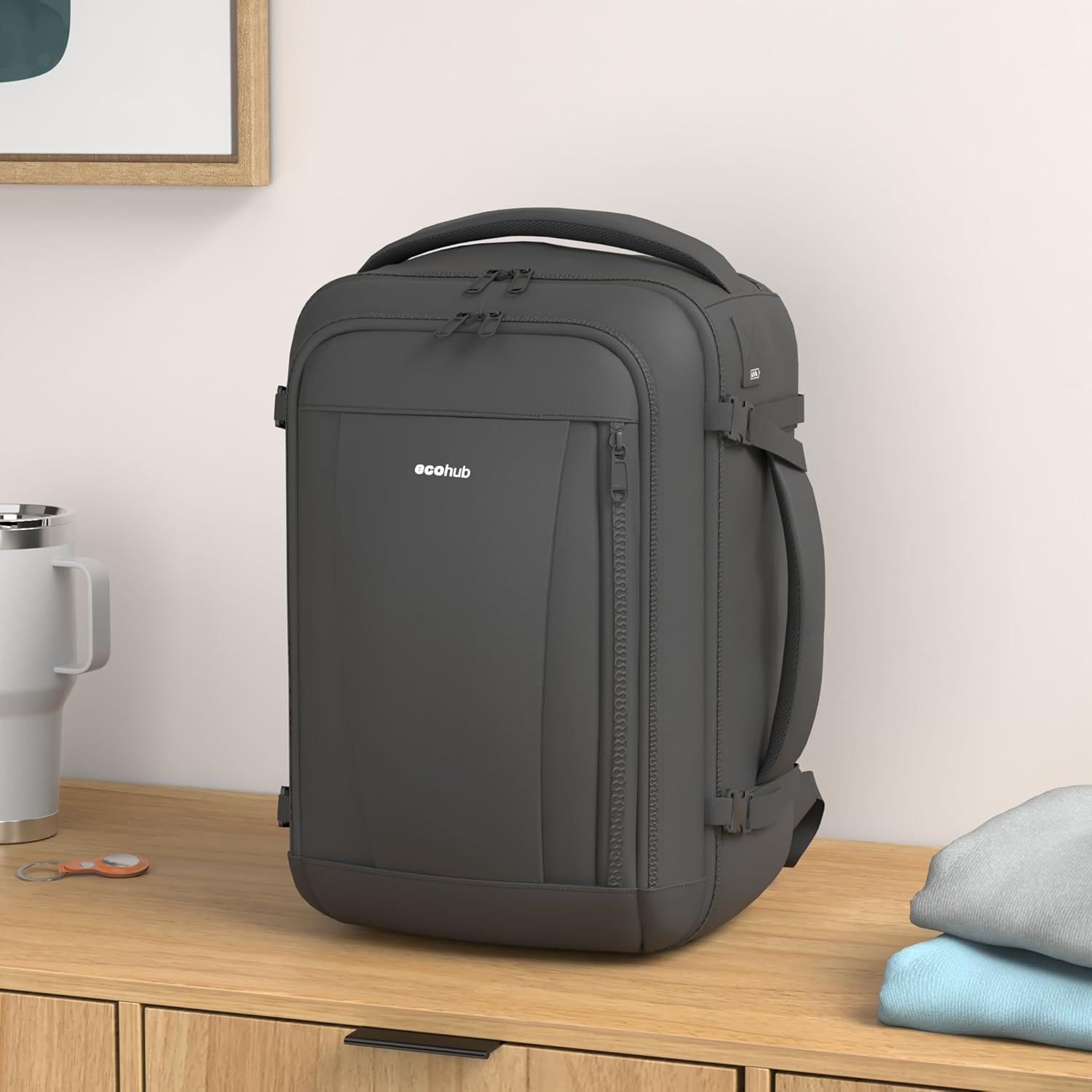
The ECOHUB personal item backpack has one of the more unusual review profiles in this category. Multiple owners describe a near-identical buying journey: deep research, nearly committing to a $200 bag, then purchasing ECOHUB same-day out of frustration when other options kept failing on fit, price, or availability. What’s interesting is what happens after that purchase. Owners who expected a compromise report coming away genuinely satisfied — some calling it better than the premium alternatives they’d been considering.
The pattern in aggregated reviews points to a few consistent strengths: it fits the under-seat gauge reliably when packed to a reasonable load, the organization is more thoughtful than the price suggests, and it carries comfortably for a packable, soft-sided bag. It is not a technical pack and it is not trying to be. But for travelers who want a capable, compliant personal item bag without spending $150+, it’s the kind of discovery that gets shared. According to SmarterTravel’s personal item size guides, soft-sided bags like this one are significantly more likely to pass gate enforcement because agents can visually assess compressibility — a genuine practical advantage at the price point.
For
$24.99
In stock on Amazon
Check price on AmazonSpirit-Spec Underseat Bag with Wet Pocket: The Multi-Airline Compliance Case Study
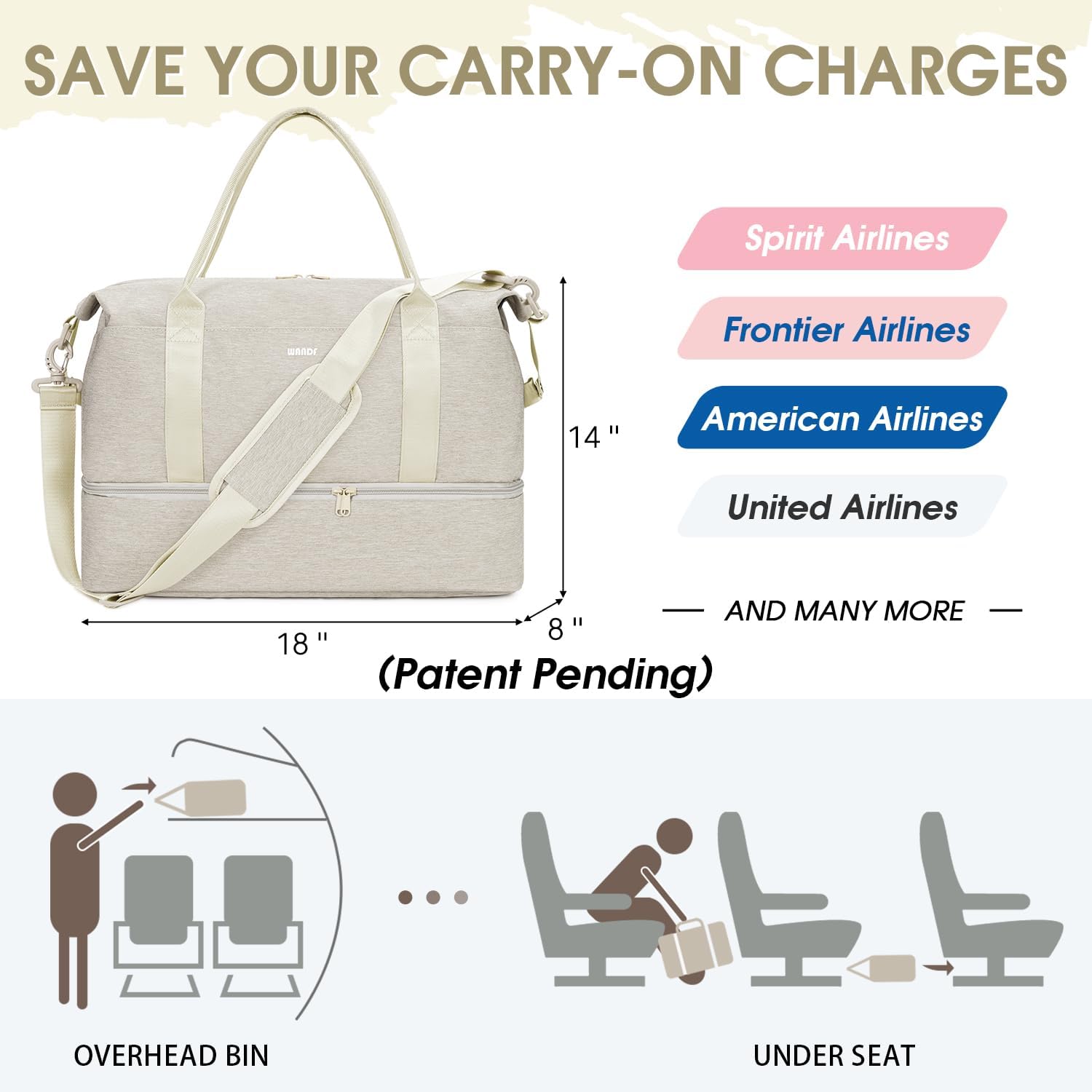
If you fly budget carriers — Spirit, Frontier, Breeze — the personal item rules are more aggressive than on major network airlines. Spirit’s published personal item dimensions are 18 × 14 × 8 inches, with active enforcement that The Points Guy’s airline baggage policy coverage has consistently flagged as among the strictest in the U.S. market. Finding a bag with documented, owner-confirmed compliance across multiple budget carriers is genuinely useful.
The Spirit-spec underseat bag with wet pocket addresses exactly this concern. Owners cite real-world testing across Delta, Frontier, and Breeze — the kind of multi-airline compliance data that travelers search for but rarely find consolidated in one place. The wet pocket is a legitimately useful addition for anyone who packs a swimsuit or gym kit without wanting damp fabric against electronics. SeatGuru’s airline baggage policy database is the most reliable reference for confirming dimension requirements on specific routes, since allowances vary meaningfully between carriers and even between aircraft types on the same airline. For budget-carrier frequent flyers, this bag deserves a shortlist position.
For
$24.99
In stock on Amazon
Check price on AmazonLOVEVOOK 40L: The Social-Proof Case
One of the strongest signals a bag can send in the mid-market isn’t a star rating — it’s repeated purchase behavior. LOVEVOOK’s 40L personal item backpack generates an unusual volume of reviews describing owners buying a second unit, or convincing family members to buy the same bag. One reviewer profile that appears repeatedly in aggregated feedback: travelers in the 60+ age bracket specifically seeking a lightweight under-seat bag to avoid overhead bin hassle. A buyer citing ease of access and light carry weight as the deciding factors is a useful signal for anyone who finds the premium market skewing toward technical features they don’t need.
The 40L volume claim deserves scrutiny — see the FAQ below for an honest treatment — but owners consistently report fitting meaningful loads (13-inch laptops, a change of clothes, travel documents) without triggering gate checks. For the price, the organization-to-weight ratio is genuinely competitive. Condé Nast Traveler’s editor-tested roundups of personal item bags have noted that lightweight construction matters more to frequent flyers than it might appear in spec sheets, because cumulative carry fatigue across a travel day is real.
For
$24.99
In stock on Amazon
Check price on AmazonTaygeer: The Honest Flaw That Distinguishes It
Most backpack reviews in this price tier are uncritically positive. The Taygeer personal item backpack is worth highlighting partly because it isn’t. A specific, repeated design complaint surfaces in otherwise favorable reviews: the laptop sleeve is positioned at the front of the bag rather than the back panel, which causes the bag to tip forward when loaded with heavier machines. This is the kind of flaw that disappears in a marketing description but shows up consistently in owner experience. Carry-heavy laptops — 15-inch machines, anything over 4 lbs — amplify the problem noticeably.
This doesn’t make it a bad bag. Owners who don’t carry large laptops, or who use it primarily as a clothing-and-accessories pack, rate it well overall. But it’s a useful illustration of why spec-sheet comparisons miss things that aggregated owner reviews catch. For laptop-primary users, the tipping issue is a dealbreaker. For everyone else, it’s a fine option at the price. The Points Guy’s carry-on and personal item guides have noted that front-loaded organization schemes work well for document and accessory access but introduce exactly this balance problem when dense items occupy forward pockets — it’s a design tradeoff worth knowing before you buy.
ECOHUB
$32.99
In stock on Amazon
Check price on AmazonOsprey Daylite: When the Premium Is Actually the Point
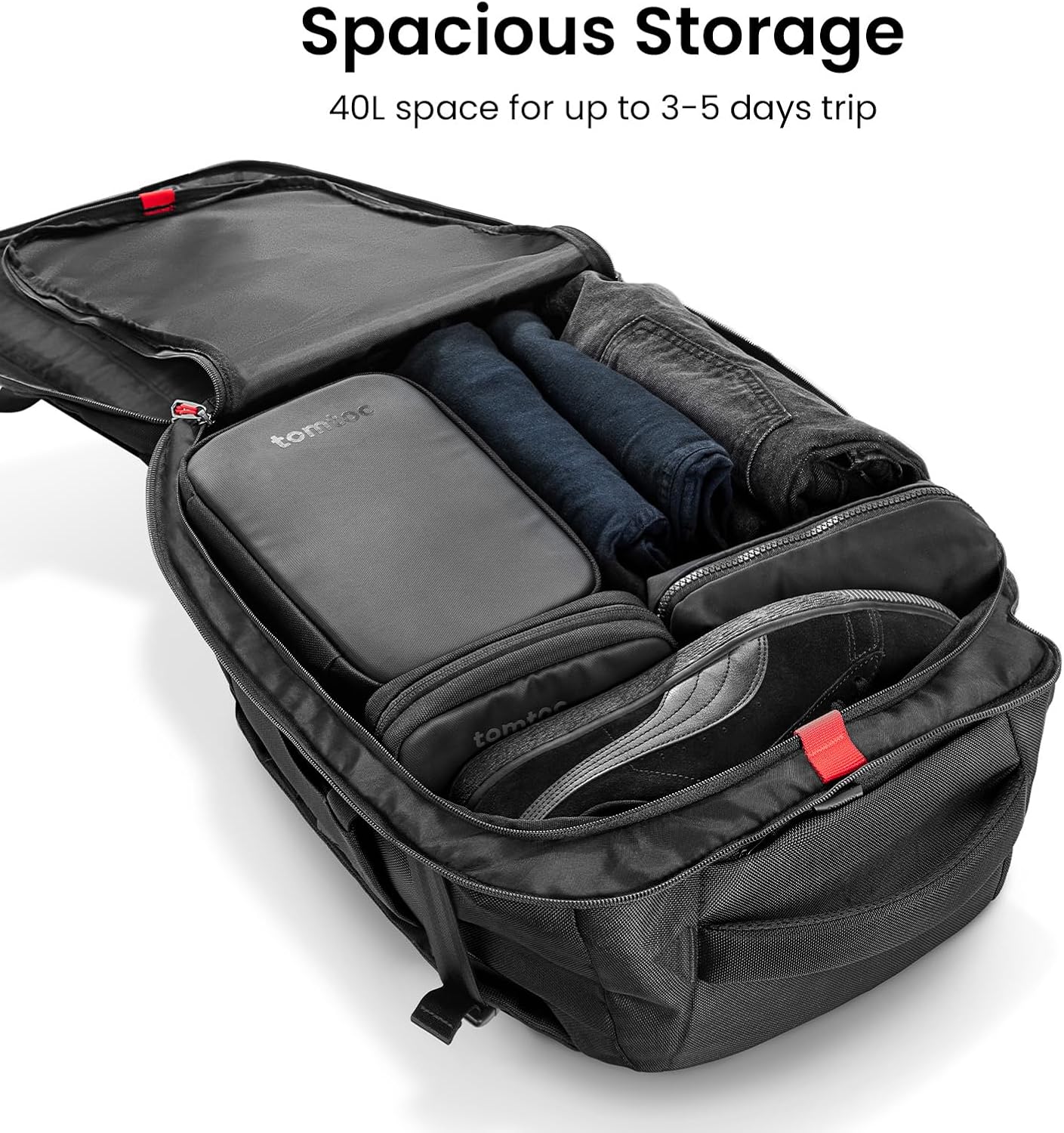
Osprey’s Daylite sits in a different category from the other bags on this list — not because it’s a personal item bag by design, but because a consistent subset of owners use it that way and report it working extremely well. The recurring theme in Daylite reviews isn’t that it’s the best standalone bag; it’s that it’s the best secondary bag. Owners consistently cite the luggage handle pass-through as the feature that justifies the premium — specifically for travelers pairing it with a rolling carry-on and treating the Daylite as an organized, accessible personal item that rides on top of the suitcase through the airport, then comes off for independent use at the destination.
Condé Nast Traveler’s coverage of travel daypacks has noted Osprey’s build consistency across its lineup, and the Daylite benefits from the same harness and back-panel quality that characterizes the brand’s technical bags. REI’s Osprey Daylite product learning content further confirms the pass-through sleeve compatibility with wheeled luggage as a primary design feature rather than an afterthought. If you travel frequently with a rolling carry-on and find yourself wanting a personal item that doubles as a capable daypack — for a city walk, a hike, a day at a conference — this is the bag that earns its price. For travelers who check luggage and just need something for the seat back pocket and under-seat slot, it’s probably more bag than the use case demands.
tomtoc
$89.99
In stock on Amazon
Check price on AmazonBy the Numbers
| Bag | Approx. Price | Claimed Volume | Key Owner-Reported Strength | Notable Flaw | Tier |
|---|---|---|---|---|---|
| ECOHUB | ~$35–45 | ~30–35L | Fit compliance; value discovery | Not a technical pack | For — $24.99 |
| Spirit-Spec Underseat | ~$30–40 | ~25–30L | Multi-carrier compliance data | Smaller volume ceiling | For — $24.99 |
| LOVEVOOK 40L | ~$45–60 | 40L | Lightweight; repeat-buy social proof | 40L claim needs honest packing | For — $24.99 |
| Taygeer | ~$35–50 | ~30–40L | Price-to-organization ratio | Laptop sleeve placement causes tipping | ECOHUB — $32.99 |
| Osprey Daylite | ~$65–85 | ~20L | Pass-through sleeve; build quality | Smaller volume; premium for the size | tomtoc — $89.99 |
Prices reflect mid-2026 market conditions and vary by retailer and configuration.
Frequently Asked Questions
Will a 40L backpack actually fit under an airline seat as a personal item, or does it have to go overhead?
It depends on how you pack it, not just what the label says. A soft-sided 40L bag that’s lightly packed — say, 60–70% full — can compress to fit the roughly 18 × 14 × 8-inch under-seat envelope on most aircraft. A rigid or fully loaded 40L bag almost certainly won’t. SmarterTravel’s personal item size guides note that soft-sided bags are significantly more likely to pass enforcement because gate agents can visually assess compressibility. If you’re claiming 40L fits, pack it like you mean to fly with it — not to the brim.
How do I know if a backpack is genuinely 18 × 14 × 8 inches when packed versus when empty?
You don’t, until you pack it. Manufacturers measure empty bags, sometimes at the most favorable dimension. The useful test: fill the bag with what you actually plan to carry, set it on the floor, and measure it with a tape measure on all three axes. Soft-sided bags will compress differently depending on contents. SeatGuru’s airline baggage policy database is a reliable reference for confirming the specific gauge size on your route, since dimensions vary — United’s personal item allowance differs from Spirit’s, and aircraft type within the same airline can also affect the under-seat space available.
Is there a meaningful quality difference between a $35 personal item bag and a $150 one for occasional travelers?
For a traveler who flies four to six times a year and uses the personal item slot for a laptop and light overflow, the honest answer is: probably not enough to matter. The differences that show up at $150+ — harness quality, suspension, materials durability — accrue over hundreds of carry hours. Occasional travelers don’t accumulate those hours. Where quality starts to matter even at lower frequency is in zipper reliability (a failed zipper at the gate is a bad day) and structural integrity when the bag is consistently packed heavy.
What happens if my personal item backpack is slightly over the size gauge at the gate?
Gate enforcement varies dramatically by airline, route, and load factor. Budget carriers — Spirit and Frontier specifically — use physical sizers more consistently than legacy carriers, a pattern that The Points Guy’s airline baggage policy coverage has documented repeatedly. SmarterTravel’s guide on oversized carry-ons notes that a soft bag that compresses into compliance when placed in the sizer is almost always waved through; a rigid bag that doesn’t fit is more likely to get gate-checked for a fee. The practical advice: if you’re flying a budget carrier with a bag you’re uncertain about, compress it as much as possible before approaching the gate, and load it so it’s not visibly overstuffed.
Does a personal item backpack with a built-in USB charging port work without a power bank, and is that feature actually useful?
A built-in USB port is a pass-through port — it routes a cable from the outside of the bag to the inside, where you plug in a power bank you’ve placed there. The bag itself stores no power. Without a power bank inside, the port does nothing. Whether it’s useful depends entirely on whether you already carry a power bank (most frequent travelers do) and whether you find it inconvenient to dig into your bag to plug in a phone. For occasional travelers who don’t carry power banks, it’s a feature they’ll never use. For frequent flyers who already run a power station in their kit, the pass-through is a genuine quality-of-life improvement.
The Decision Rule
Here’s the honest if/then:
If you fly occasionally (under 8 times a year), use the personal item slot primarily for overflow and light carry, and aren’t pairing the bag with a rolling suitcase: a well-reviewed bag in the $30–50 range — ECOHUB, LOVEVOOK, or the Spirit-spec underseat bag depending on your airline mix — is the right call. The premium features you’d be paying for at $150+ won’t see enough use to justify the gap.
If you fly frequently, carry a laptop as a primary item, and want a personal item that doubles as a functional daypack at your destination: the Osprey Daylite or a comparable mid-tier option earns the price through genuine feature differentiation — the pass-through sleeve, the harness quality, the build longevity.
If you’re primarily flying budget carriers and compliance is your top concern: the Spirit-spec underseat bag with multi-airline owner-testing data is the most directly useful option on this list.
The $200 bag isn’t wrong. It’s just not always right. Match the bag to the use case, and you’ll spend appropriately — and stop leaving value in the overhead bin.