September 21, 2026 • Maren Solley • 11 min reading time • Prices verified June 12, 2026
The Personal Item Bag Ecosystem: Pairing a Backpack With a Carry-On That Actually Works
Most airlines allow every passenger two pieces of luggage in the cabin: one carry-on (the larger bag, which goes in the overhead bin above your seat) and one personal item (the smaller bag, which slides under the seat in front of you). That sounds simple, but in practice the two-bag system is one of the most misunderstood parts of modern travel. Get the pairing wrong and you’re either gate-checked at the jetway — a fee that routinely runs $50–$100 on budget carriers in 2026 — or you’re spending a weekend trip wrestling a bag that’s technically legal but practically miserable. Get it right and you move through airports faster, keep your essentials within reach during the flight, and almost always have a free overhead slot waiting for you. This guide is written for travelers who already know the basics and are ready to build a deliberate two-bag system: one overhead bag and one under-seat bag that were chosen to work together, not just tolerated side by side.
| EDITOR'S PICKtomtoc Travel Backpack 40L | Mid-tierECOHUB Travel Backpack 18x14x8… | Budget pickMATEIN Carry on Backpack | |
|---|---|---|---|
| Capacity | 40L | — | 40L |
| Fits laptop | 17.3 in | — | — |
| Dimensions | — | 18x14x8 in | — |
| Expandable | — | — | ✓ |
| Price | $89.99 | $32.99 | $26.99 |
| See on Amazon → | See on Amazon → | See on Amazon → |
Why the Pairing Matters More Than Either Bag Alone
The two-bag traveler’s failure mode isn’t buying a bad bag — it’s buying two fine bags that don’t interact well. The overhead bag is too heavy to hoist without help. The personal item is too rigid to compress when the under-seat space turns out to be shallower than SeatGuru’s dimensions suggested. The laptop lives in the overhead bag, which gets gate-checked, and suddenly you’re separated from your work machine on the tarmac for forty minutes.
Treating both bags as a system from the start changes every decision downstream.
The overhead bag is your volume carrier. Clothes, shoes, toiletries, a packable layer — everything that can survive a few minutes of separation lives here. The personal item is your command center. Laptop, passport, medications, snacks, chargers, the document you need at immigration — anything you’d genuinely regret losing access to for the duration of a flight goes under the seat in front of you.
The Points Guy’s 2025 roundup of airline enforcement trends notes that Spirit, Frontier, and Ryanair-model carriers have continued to tighten enforcement at the gate, with agents increasingly using physical bag sizers for personal items — not just carry-ons. That enforcement pressure has migrated upmarket: even travelers on legacy carriers report more scrutiny on transatlantic budget cabin bookings that include only a personal item allowance. The practical implication is that your personal item’s dimensions matter as much as its contents, and that a bag designed specifically for the under-seat slot — with a structured silhouette that fits the sizer — gives you more negotiating room than a boxy tote that “might” fit.
Sizing the System: What the Numbers Actually Tell You
The standard personal item envelope that most major U.S. carriers publish is around 18 × 14 × 8 inches, though this varies by airline and aircraft. SeatGuru’s per-aircraft under-seat dimension guides show meaningful variation: a narrowbody regional jet can have a center seat under-seat clearance as low as 9 inches tall, while a wide-body international aircraft might offer 11–12 inches. The safest personal item is one that stays under 18 × 14 × 8 regardless of where you sit.
By the numbers: two-bag carry-on limits on major U.S. carriers (2026)
| Carrier | Carry-On Max | Personal Item Max | Enforcement Trend |
|---|---|---|---|
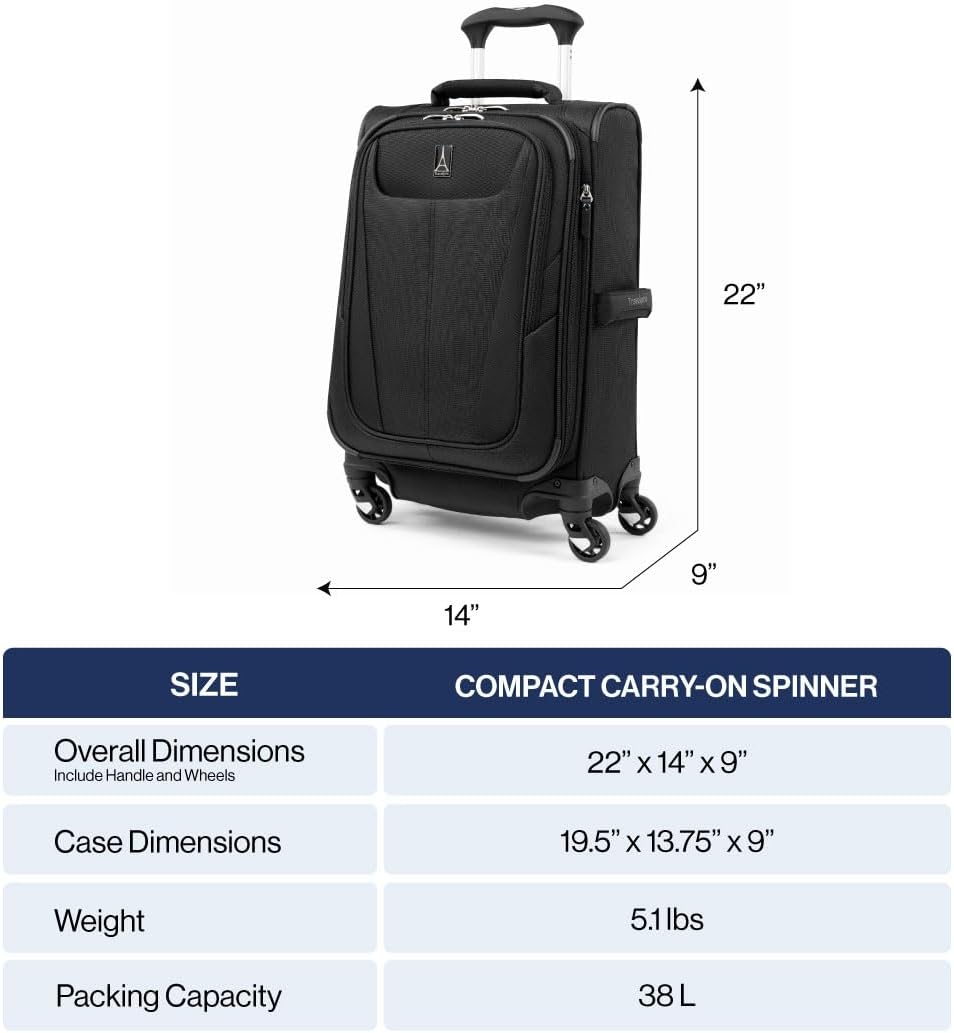
| Delta / United / American | 22 × 14 × 9 in | 18 × 14 × 8 in | Moderate — gate agents vary |
| Southwest | 24 × 16 × 10 in | 18.5 × 8.5 × 13.5 in | Low — generally permissive |
| Spirit / Frontier | 22 × 18 × 10 in | 18 × 14 × 8 in | High — physical sizers in use |
| Alaska | 22 × 14 × 9 in | 17 × 13 × 6 in | Moderate — tightened in 2025 |
Sources: individual airline published policies; The Points Guy 2025 enforcement roundup.
Notice Alaska’s personal item allowance — at 17 × 13 × 6 inches, it’s meaningfully smaller than the standard, and it catches travelers who optimized their personal item for Delta and then booked a connecting Alaska flight. Building your system around the most restrictive envelope you regularly fly means you never need to re-evaluate.
Choosing Your Overhead Bag: The Backpack-vs.-Hardshell Decision
The overhead slot accommodates either a rolling carry-on suitcase or a backpack — and which you choose shapes the entire system.
Rolling carry-on suitcases organize better. Packing cubes lay flat, you can access the full interior at once, and they roll through airports without fatigue. The tradeoff: they’re harder to gate-check gracefully (wheels take damage), and on flights where overhead bin space fills early, a rolling suitcase competes with everyone else’s rolling suitcase for the same real estate.
A high-volume travel backpack — something in the 30–45L range — compresses into odd overhead spaces, can be gate-checked without the same anxiety about wheel damage, and converts to a usable daypack at the destination. Owners of bags like the Osprey Farpoint 40 consistently describe the flexibility of being able to squeeze the bag into a side-overhead slot when the facing bins are full, something a rigid hardshell simply can’t do. The LOVEVOOK 40L has built a following among budget-conscious travelers specifically because reviewers note that fitting it under the seat — it can genuinely slide under many wide-body under-seat spaces when stuffed lightly — freed their overhead slot for a small rolling bag on a shared trip. That’s an advanced two-bag maneuver worth knowing.
The decision rule: if you travel with a checked-bag-averse companion or routinely fly routes where bins fill before boarding group 4, a compressible backpack overhead gives you system flexibility a hardshell can’t match. If you value fast packing, easy organization, and reliable spin-through airports, a rolling carry-on is the right overhead anchor.
Choosing Your Personal Item: What Owners Actually Care About
The personal item bag market has matured significantly. Budget options have improved; premium options have added genuine features. Based on aggregated owner reviews and Condé Nast Traveler’s 2025 evaluation of personal item bags, the features that separate good from frustrating are:
Luggage pass-through sleeve. A horizontal sleeve on the bag’s back panel that slides over a rolling suitcase handle. Osprey Daylite owners consistently cite this as a feature they didn’t know they needed until they used it — and reviewers of cheaper bags without it describe airport fatigue from managing two separate bags with their hands. If your overhead bag is a rolling carry-on, a pass-through sleeve on your personal item is close to mandatory for a multi-leg trip.
Structured silhouette that holds its shape empty. Soft totes that collapse in the sizer look smaller than they measure and can actually be harder to slide under the seat because they bunch up. A bag with light panel structure fills its own footprint predictably.
A dedicated laptop compartment with a padded back panel. This is the feature that determines where your laptop lives. The right answer — contrary to what many travelers default to — is almost always the personal item. SmarterTravel’s 2025 enforcement guide and AFAR’s packing methodology piece both flag the same scenario: when a carry-on gets gate-checked at the jetway, anything inside it leaves your control. If your laptop is in your personal item, it stays with you regardless of what happens to the overhead bag.
The ECOHUB bag hack worth stealing. Reviewers of the ECOHUB personal item bag — across multiple aggregated review threads — describe repurposing the bag’s dedicated laptop sleeve for their TSA liquids bag instead. The laptop moves to a padded interior pocket, and the flat exterior sleeve holds a quart bag that can be pulled out instantly at security without opening the main compartment. This is the kind of workflow optimization that doesn’t appear in any spec sheet but surfaces in real-use owner reports. The geometry works because laptop sleeves and TSA quart bags share a similar flat, wide profile.
Trolley sleeve durability. This one matters more than the marketing suggests. Owners of bags with lightweight trolley sleeve stitching — particularly on bags under $60 — report the sleeve separating from the back panel after 15–20 flights, often at the lower attachment point where the weight concentrates. If you’re buying a personal item bag you intend to use for two or more years of regular travel, check whether the trolley sleeve reinforcement is stitched through the bag’s frame or only attached to the outer fabric panel. Bags with frame-integrated sleeves — including several Osprey and Bellroy designs — hold up markedly better in long-run owner reviews.
Splitting Your Packing Without Losing Track
The most practical question about a two-bag system isn’t which bags to buy — it’s how to mentally organize the split so you never spend ten minutes at a gate trying to remember which bag has your passport.
AFAR’s packing methodology guide suggests organizing by access timing, not by category. Everything you need before landing — documents, devices, medications, chargers, snacks, anything you’d open mid-flight — goes in the personal item. Everything that can wait until you reach the hotel goes overhead. This sounds obvious but it contradicts the instinct to pack by category (clothes together, tech together), which tends to scatter flight-critical items between both bags.
A practical two-zone checklist for the personal item:
- Passport and boarding passes (physical backup)
- Laptop and charging cable
- Medications (especially anything time-sensitive)
- Portable battery / power bank
- Earbuds or headphones
- One change of underwear and a toothbrush (insurance against a gate-checked overhead bag)
- Liquids bag
That last item — the insurance layer — is the move that separates anxious travelers from composed ones. Gate-checking happens. It happens on full flights, it happens when you board late, it happens on regional connectors where the overhead bins were never going to fit everyone’s bags. Having a bare-minimum overnight kit in your personal item means a gate-checked carry-on is an inconvenience rather than an emergency.
Frequently Asked Questions
Can a 40L backpack genuinely replace a carry-on suitcase as the overhead item? Yes, with conditions. A 40L soft-sided backpack typically falls within most major U.S. airline carry-on envelopes when packed to its rated volume. The practical advantage over a hardshell is compressibility — if the overhead is full, a 40L backpack can sometimes be squeezed into a side slot a rolling bag couldn’t fit. The disadvantage is organization: backpacks require more deliberate packing (cubes help significantly) to avoid a chaotic dig-through at the hotel. Owners who make the switch consistently report that the organizational learning curve is real but short.
What is the actual difference between a personal item and a carry-on backpack in airline enforcement? Size and placement. A carry-on backpack is sized to the overhead bin envelope (roughly 22 × 14 × 9 inches on most U.S. carriers) and is expected to go overhead. A personal item backpack is sized to the under-seat envelope (roughly 18 × 14 × 8 inches) and is expected to go under the seat. Airlines enforce this distinction most aggressively on budget carriers with bag-fee revenue models. On a full legacy-carrier flight, a 22L bag will rarely trigger scrutiny whether it goes overhead or under the seat — but on Spirit or Frontier, an oversized personal item at the gate sizer will generate a fee.
Which bag should hold the laptop — the overhead bag or the personal item? The personal item, without exception. When a carry-on is gate-checked, it leaves your control until baggage claim or the jetway on arrival. Your laptop should never be in a bag that could be separated from you, even briefly. The personal item stays under the seat in front of you for the entire flight.
How do you split packing between two bags without losing track of your stuff? Organize by access timing, not category. Personal item holds everything you need before or during the flight. Overhead bag holds everything that can wait until the destination. Within those zones, packing cubes by type (one cube for tops, one for bottoms, one for tech accessories) prevent the mid-trip chaos of a single unsorted bag.
Does the trolley sleeve on a personal item bag hold up under real use? It depends heavily on construction quality. Frame-integrated trolley sleeves on bags from established travel-gear brands hold up well through years of regular use, according to long-run owner reviews. Stitched-only sleeves on budget bags under $60 show failure patterns — typically at the lower attachment point — after 15–20 flights. If you’re buying a bag you plan to use for more than a year of regular travel, trolley sleeve construction quality is worth examining before purchase.