September 15, 2026 • Maren Solley • 9 min reading time • Prices verified June 12, 2026
Packing Cubes by Trip Length: The Right Set for a Weekend Versus a Month Abroad
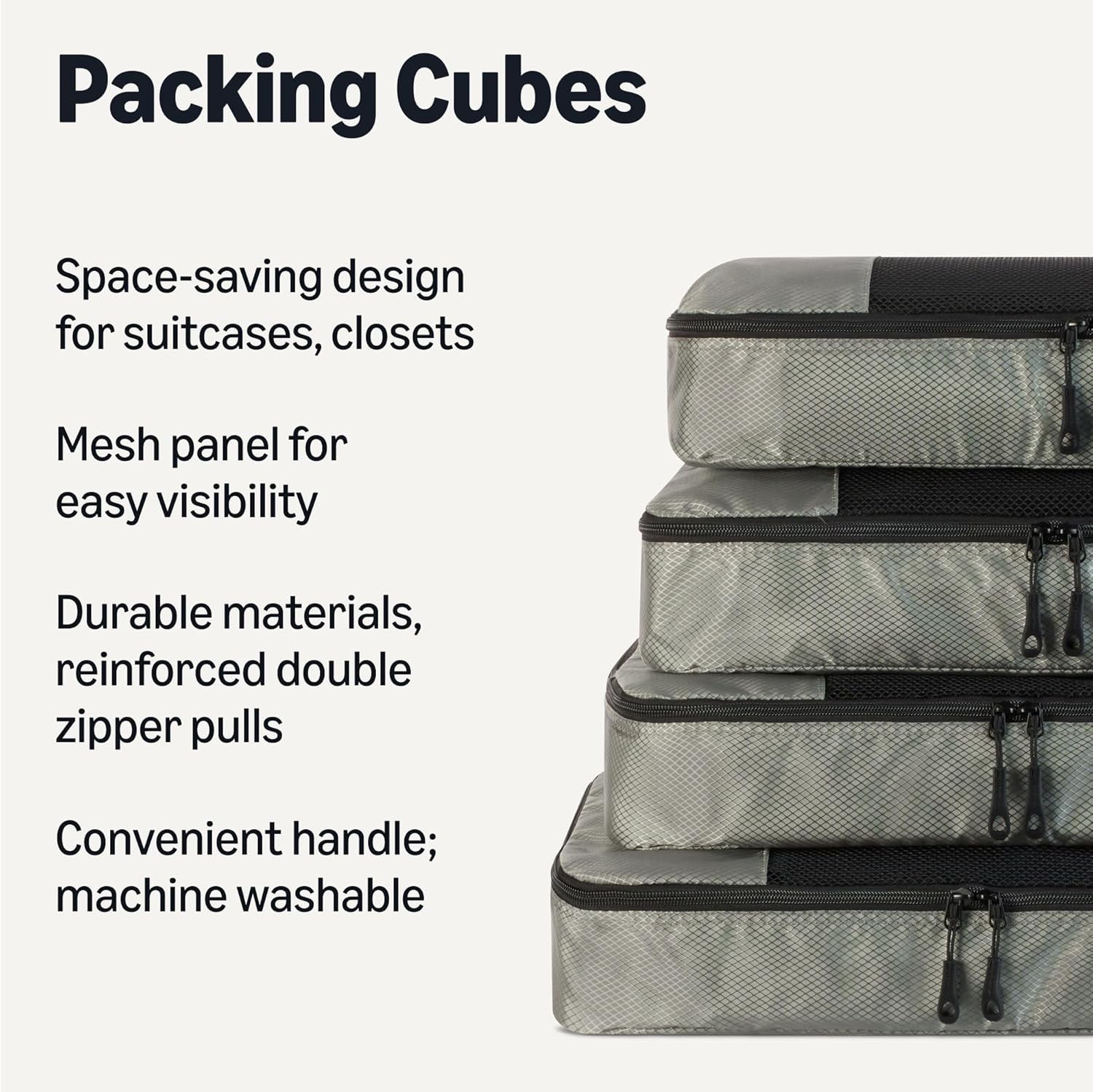
Packing cubes are zippered fabric pouches — think of them as portable dresser drawers — that you slot inside a suitcase or backpack to keep clothing and gear grouped by category instead of loose and chaotic. You put shirts in one, bottoms in another, and underwear and socks in a third. The bag stays organized through multiple hotel moves, and when you arrive, the cubes lift straight out and drop into a drawer. That’s it. They don’t compress your clothes the way a vacuum bag does (more on that misconception shortly), and they don’t reduce what you can pack — they just make the space you have far easier to manage. If you’ve bought your first set and wondered what all the fuss was about, you probably had the wrong size mix for your trip. This guide solves that: here’s exactly which cube setup maps to a weekend trip, a one-to-two-week jaunt, and a month-plus expedition, with the tradeoffs named plainly at every step.
| EDITOR'S PICKShacke 5 Set Packing Cubes for… | Mid-tierBAGAIL 8 Set Packing Cubes Lugg… | Budget pickAmazon Essentials 4-Piece Packi… | |
|---|---|---|---|
| Pieces in set | 5 | 8 | 4 |
| Laundry bag | ✓ | — | — |
| Mesh top | — | — | ✓ |
| Double zipper | — | — | ✓ |
| Size option | — | — | Large |
| Color | Black | Jet Black | Gray |
| Price | $26.99 | $19.99 | $18.89 |
| See on Amazon → | See on Amazon → | See on Amazon → |
The Myth of Compression — and Why Organization Is the Actual Win
This is the single most consistent misunderstanding that first-time buyers report. Across aggregated reviews of virtually every mid-market cube set, a recurring pattern emerges: buyers expect the cubes to compress their clothes into a smaller footprint and feel underwhelmed when that doesn’t happen. One Amazon Essentials reviewer articulates the realization almost word-for-word: they ordered expecting compression, discovered the real value is organization, and ended up becoming a convert anyway.
The distinction matters for buying decisions. If your goal is true compression — squeezing a winter sweater down by 40% — you want compression sacks (a different product entirely, with one-way valves or roll-top seals). If your goal is arriving at a hotel in Lisbon with your shirts intact, your socks in one place, and the ability to move everything from bag to drawer in under two minutes, packing cubes are the right tool.
The secondary benefit that long-term travelers lean on heavily — and that AFAR’s packing cube explainer highlights — is transferability: you pull the whole cube out of your rolling carry-on, set it in the dresser, and re-pack in seconds without touching individual garments. A 100,000-mile-per-year traveler who reviewed the Shacke Pak cube set makes this point directly: the system saves time not at pack-out, but at every single hotel check-in and check-out across a year of constant travel.
Smarter Travel’s packing guide draws a useful distinction here: cubes add value proportional to how often you’re moving. A traveler staying one week in a single Airbnb gains less than a traveler hitting four cities in ten days.
Weekend Trips (1–3 Nights): One or Two Cubes, Maximum Simplicity
The case for fewer cubes: A weekend trip — city break, long weekend, domestic flight — typically means a personal item-sized bag or a small carry-on. You’re packing two or three outfit changes, a toiletry kit that likely stays separate, and whatever tech you carry daily. A full six- or eight-cube set is overkill and will feel like you’re managing the organization system rather than the trip.
What actually works: One medium cube (typically 11” × 7”) for tops, one small cube (roughly 9” × 5”) for underwear and socks. That’s it. The cubes slide into your bag, come out at the hotel as a unit, and you’re done. Wirecutter’s packing cube coverage consistently notes that smaller trip-specific kits outperform oversized sets for short travel because there’s less dead air space inside each cube — a half-full large cube is floppy, hard to stack, and wastes volume.
The size-mismatch problem is real. One Amazon Basics family reviewer noted that her husband rejected both the large and small cubes from their mixed set and only ever used the mediums. That’s a common outcome. For weekend travel, if you’re buying a full set, check whether you can actually use the large at your volume — if you’re not filling it, it’s wasted space and a loose brick in your bag.
The right pick here: A two-cube subset of any reputable mixed set, or a dedicated small/medium duo. The Travel Wise set has earned a remarkable durability signal from long-term owners — one owner reports daily use across five years of van travel with intact zippers and seams, which is the kind of evidence that matters more than short-term reviews.
One to Two Weeks (Standard Carry-On or 40L Backpack): The Sweet Spot for a Mixed Set
This is where packing cubes earn their reputation, and where most buyers should focus their research.
By the numbers:
| Trip length | Bag size | Recommended cubes | Typical breakdown |
|---|---|---|---|
| 1–3 nights | Personal item / 20L | 2 cubes | 1 medium tops, 1 small bottoms/socks |
| 4–7 nights | Carry-on / 30–40L | 3–4 cubes | 2 medium, 1 small, 1 slim for accessories |
| 8–14 nights | Carry-on or checked / 40–50L | 4–6 cubes | 2 large, 1–2 medium, 1 small, 1 laundry |
| 15+ nights | Checked or expedition pack | 6–8 cubes | Full set by category |
For a 7-night carry-on trip, the classic three-cube configuration — large for bottoms and heavier items, medium for tops, small for underwear and socks — fills a standard 22” carry-on efficiently without dead space. Condé Nast Traveler’s packing cube round-up consistently recommends a mixed-size set over a uniform set for this exact trip profile, because different garment categories compress differently.
The self-described over-packer angle: BAGAIL’s 8-cube set attracts a specific buyer type — reviewers who identify as chronic over-packers find that more cubes, not fewer, give them the granular category separation they need to stay honest about what’s in the bag. When every category has its own cube, a stuffed cube becomes visible evidence that you’ve overpacked a category, which creates a natural check. If that describes you, the eight-cube format is genuinely useful rather than excessive.
For technical backpack travelers: Osprey Ultralight cube reviewers come from a noticeably different travel culture than general luggage users. These are 25L–50L backpack users who care about gram counts, not just organization. Osprey’s ultralight cubes use thin ripstop nylon and minimal hardware — published specs put the small at around 30g. If you’re optimizing a 30L daypack-as-carry-on, the weight penalty of a standard polyester cube set is real and the ultralight category is worth the price premium. For everyone else packing into a spinner or standard travel backpack, weight difference between a budget set and a premium set is noise.
Month-Plus Travel and Location-Independent Packing: System Thinking Over Individual Cubes
At a month or longer, you stop thinking about individual cubes and start thinking about a packing system. The variables shift: you’ll be doing laundry in-trip (hand wash or laundromat), you’ll repack multiple times, and the wear patterns on zippers and mesh panels start to matter.
Durability becomes the deciding factor. The Travel Wise five-year van travel example isn’t anecdotal noise — it’s the relevant signal for this use case. At this trip length, a $10 cube set that blows a zipper pull in month two is a worse value than a $25 set that runs for years. The cost-per-trip math strongly favors mid-tier and premium sets once you’re past the 20-trip mark.
The laundry cube: Long-haul travelers consistently recommend dedicating one cube — typically the small — as a dirty laundry separator. It’s a simple system: clean clothes live in their cubes, worn clothes go into the designated dirty cube. You always know what’s clean. This is a setup detail that doesn’t appear on product pages but shows up repeatedly in extended-travel reviews.
The Shacke Pak YouTube problem is a setup signal, not a product flaw. One Shacke Pak reviewer mentions needing to watch YouTube tutorials before the cubes worked properly for them. That’s a useful flag for a month-long packer: these aren’t products with a steep learning curve, but there is a packing technique — filling cubes to capacity before zipping, folding to the cube’s dimensions rather than the garment’s natural fold — that makes a meaningful difference. Buyers who skip setup spend the first week fighting floppy, inefficient cubes.
Do you need compression cubes at month-plus? Compression cubes (with a secondary zip that cinches down the cube) are worth considering for a checked bag on extended trips where you’re carrying more than carry-on volume. But the Wirecutter review of packing cubes notes an important caveat: compression cubes that achieve significant reduction typically use heavier hardware, adding back some of the weight savings from the volume reduction. For carry-on-only travel at any trip length, standard cubes with solid zippers outperform compression cubes in total utility.
Frequently Asked Questions
How many packing cubes do I actually need for a 7-day trip in a carry-on suitcase? Three to four cubes covers most travelers: one large or two mediums for tops and bottoms, one small for underwear and socks, and optionally one slim or flat pouch for accessories or cables. More than four cubes in a standard carry-on creates a Tetris problem rather than solving one.
Should I buy a set with all the same size cubes or a set with mixed sizes? Mixed sizes almost always win for general travel. Different clothing categories pack differently — shirts fold flat into mediums, socks and underwear compress into smalls, heavier pants or sweaters fill a large. Uniform sets force you to awkwardly half-fill large cubes or overstuff small ones.
What is the correct way to pack a packing cube so it zips closed without bursting? Fill the cube to capacity, but fold garments to match the cube’s footprint rather than the garment’s natural dimensions. For a medium cube roughly 11” × 7”, fold shirts to approximately 7” wide before stacking. A cube that’s square and taut zips cleanly; a cube stuffed with awkward shapes fights the zip. When in doubt, remove one item — the cube should close with light pressure, not a struggle.
Is it worth paying more for Osprey or Thule packing cubes over $10 Amazon sets? It depends entirely on use case. For ultralight backpack travel where gram counts matter and zippers will see hundreds of cycles, yes — the materials and construction difference is real and documented by technical backpacker reviewers. For occasional leisure travel into a spinner suitcase, the $10 Amazon set does the organizational job adequately. The Travel Wise set occupies a compelling middle ground: mid-tier price, five-year durability signal from long-term owners, and a construction quality that outperforms its price point.
Can packing cubes be washed in a standard washing machine after a long trip? Most cubes made from polyester mesh or nylon can go in a washing machine on a gentle/cold cycle, but check the care label — some cubes with rigid internal structures or specific coatings recommend hand wash. Zippers generally survive machine washing fine when closed. Air dry rather than tumble dry to preserve any water-resistant coating and extend zipper life. For a month-long trip’s worth of accumulated use, a machine wash on return is completely reasonable and won’t shorten the life of a quality set.