August 11, 2026 • Maren Solley • 10 min reading time • Prices verified June 12, 2026
How to Choose the Right Packing Cube Set Size for Your Body and Your Bag
How to Choose the Right Packing Cube Set Size for Your Body and Your Bag
Packing cubes are zippered fabric compartments — think of them as portable drawers — that you slide inside your luggage to keep clothing sorted and compressed. They’ve become a near-universal recommendation for anyone who travels with a carry-on backpack or rolling bag, and for good reason: they let you unpack a category at a time, speed up airport security, and keep a week’s worth of clothes from collapsing into a single wrinkled heap. But here’s the part most buying guides skip: the mix of sizes within a set matters just as much as how many cubes you get. Buying the wrong configuration is exactly as frustrating as buying no cubes at all. This guide walks you through how to read your own body, your bag, and your typical trip length — and match all three to the right cube dimensions.
Why the Size Mix Inside a Set Is the Real Decision
Most cube sets are sold by piece count: 3-piece, 4-piece, 6-piece, 8-piece. What’s actually inside those counts varies wildly by brand, and the mismatch between what a brand ships and what a traveler actually needs shows up consistently in long-form owner reviews.
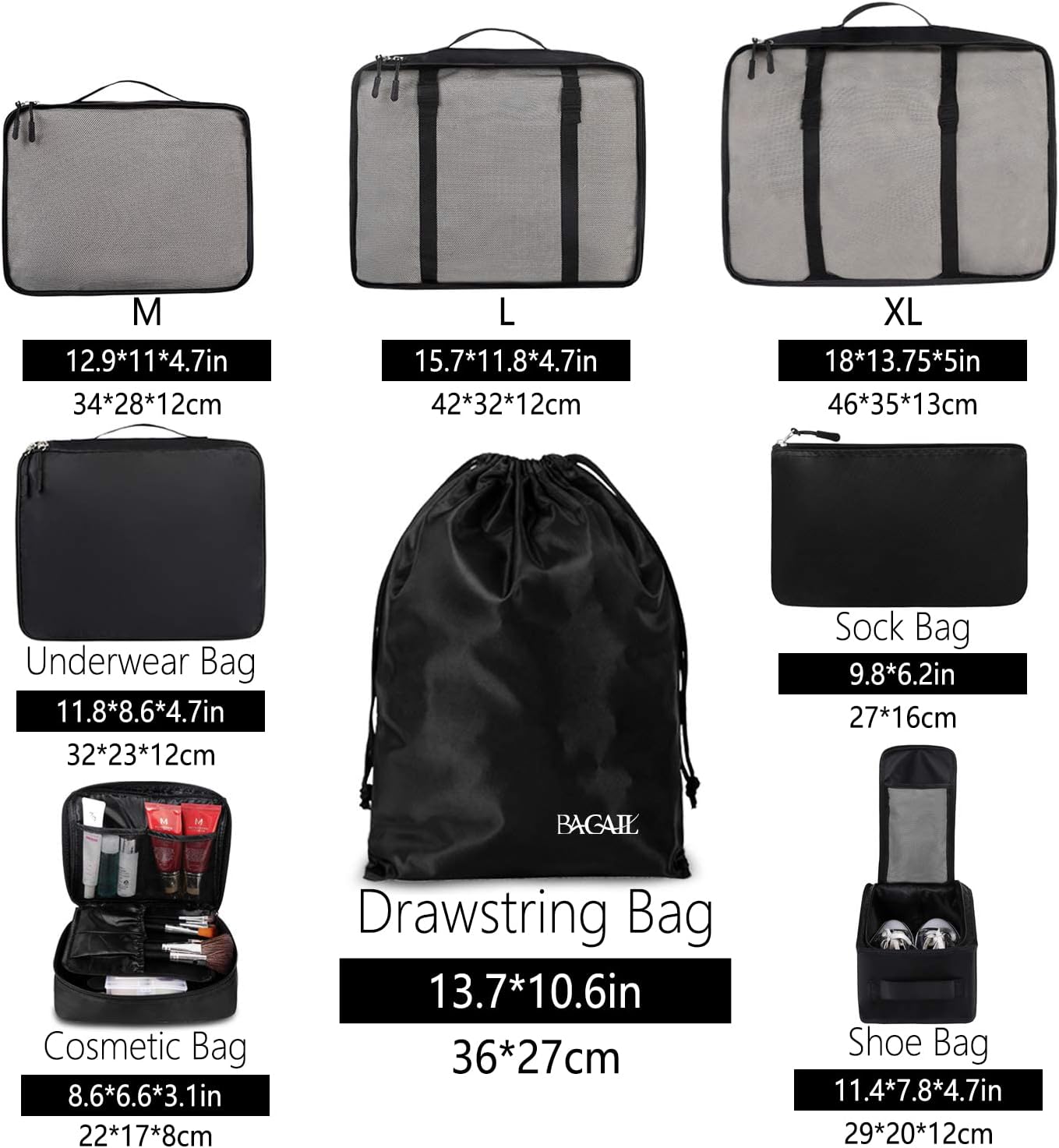
One Amazon Essentials reviewer notes that her husband found the large and small cubes in their set “completely unusable” and only wanted mediums — a real-world sizing mismatch that affects far more buyers than brands acknowledge. On the opposite end, BAGAIL owners praise being able to fit a very large man’s complete clothing kit into their set, crediting the generous large-cube dimensions. Thule compression cube owners report packing what sounds like an almost implausible amount of clothing into a single large cube — multiple shirts, pants, and base layers in one go. These are three different outcomes from three different size philosophies, and none of them is wrong — they just serve different bodies and different packing styles.
The core tradeoff is this: large cubes hold more per cube but are harder to place in irregular bag pockets and waste space when half-empty; small cubes are modular and space-efficient but multiply the number of times you’re opening and closing zippers every time you need something.
Smarter Travel’s packing cube coverage notes that experienced travelers often end up abandoning the factory set configuration entirely, mixing brands and sizes based on a personal system developed across multiple trips. That’s the right instinct — but it takes trial and error unless you understand the sizing framework going in.
Matching Cube Sizes to Your Body and Clothing Volume
Before you think about your bag, think about the clothing that actually needs to fit inside the cubes. Body size and clothing category are the two variables brands almost never address.
Men’s large-frame travelers (XL–XXL+): Standard medium cubes — typically around 13” × 9” × 3” — simply won’t close cleanly over a folded XL or XXL dress shirt, and they’re hopeless for anything like a heavyweight sweatshirt or fleece. BAGAIL’s large cubes have earned repeat mentions in owner reviews specifically for this reason: reviewers report fitting a full wardrobe for a large man where smaller-format cubes failed. If you’re building a kit and you wear XL or above, prioritize getting at least two large cubes rather than accepting the standard 1-large, 2-medium, 1-small ratio most sets ship with.
One BAGSMART compression cube buyer solved this problem by purchasing two 4-piece sets specifically to get two large cubes instead of one — a workaround that reveals a genuine gap in standard set configurations. If that’s your situation, look for brands that sell cubes individually or offer a “double-large” configuration before defaulting to the two-sets hack.
Women’s travel and light-fabric packing: Medium cubes (roughly 12”–13” in the long dimension) work well for most women’s clothing categories, including folded tops, leggings, and lightweight dresses. Small cubes — typically around 9” × 5” — shine for accessories, undergarments, and socks. If your style of travel skews toward lightweight technical apparel (merino base layers, packable down, trail running shorts), you may find a set weighted toward mediums and smalls serves you better than one large cube you can never quite fill.
Outerwear and bulky layers: Shacke Pak reviewers note that medium cubes struggle with bulky items like coats and sweatshirts — fabrics with loft simply don’t compress to a manageable volume. For heavy outerwear, either use a dedicated large compression cube (the Thule large gets specific praise for this use case) or plan to pack your outer layer outside the cube system entirely, using it as gap-fill in your bag’s main compartment.
Matching Cube Sizes to Your Bag’s Shape and Structure
Your bag’s internal geometry is the second half of the equation. Cubes that fit your clothes perfectly can still be a poor match for your specific bag.
Rolling carry-ons and checked bags (rectangular cross-section): These are the easiest to configure. A standard 22” × 14” × 9” carry-on accommodates a mix of large and medium cubes efficiently because the walls are rigid and the compartment is a predictable rectangle. REI’s packing guidance suggests filling the largest cubes first and using mediums and smalls to fill in around them — which works well in a hard-side or semi-structured soft-side roller.
Travel backpacks (top-loading, panel-loading, and frameless): This is where cube shape and depth become critical. Osprey Ultralight cube owners specifically praise compatibility with technical backpacks — the slim profile (typically around 2”–3” deep) slides into a top-loader’s main compartment without forcing the pack into an awkward barrel shape. Wirecutter’s packing cube coverage (New York Times / Wirecutter, “The Best Packing Cubes”) emphasizes that cube depth, not just footprint area, determines how well a cube fits a curved or tapered backpack body. A cube that’s 4”–5” deep may technically hold the same volume as two slim cubes, but it will create a rigid brick that prevents the pack from conforming to your back.
Personal-item bags and daypacks under 20L: Small and slim cubes are the only realistic option here. A single medium cube can take up half the usable volume of a 16L personal item. For this format, one or two small cubes for electronics cables and one flat or slim cube for clothing is the practical ceiling.
By the Numbers
| Bag type | Recommended cube configuration |
|---|---|
| 22” carry-on roller | 1–2 large + 2 medium + 1 small |
| 40–46L travel backpack | 1 large slim + 2 medium slim + 1–2 small |
| 28”+ checked bag | 2–3 large + 2–3 medium + 1–2 small |
| Under-seat personal item | 1–2 small + 1 flat/slim |
Condé Nast Traveler’s packing cube roundup consistently flags that travelers with checked bags are the most likely to over-invest in piece count and under-invest in cube volume — buying 6-piece sets when two large cubes and one medium would actually serve them better.
Compression vs. Standard: When the Cube Type Changes the Math
Standard cubes (a simple zippered pouch) organize but don’t meaningfully compress. Compression cubes add a second zip that squeezes air out of compressible fabrics, reducing volume by roughly 30–50% for knits and synthetics — though REI’s packing guidance notes that compression is minimally effective on rigid items like shoes, hard-shell electronics cases, or denim.
The practical tradeoff: compression cubes are heavier, cost more, and add a step to packing and unpacking. For a 3-night weekend trip with a carry-on, that trade rarely makes sense. For a 3-week trip where you’re checking a bag or filling a 46L backpack, compression cubes in the large format can meaningfully change how much you fit — or let you downsize to a smaller bag.
Thule compression cube owners reporting near-implausible clothing density in their large cube are almost certainly benefiting from this compression effect on mid-layer fabrics (fleece, merino, synthetics). Apply that same expectation to denim or cotton-canvas and the results will disappoint.
Frequently Asked Questions
Can you mix packing cube brands in the same suitcase? Absolutely. There’s no compatibility standard to match — cubes from different brands coexist fine in any bag. Mixing is, in fact, the approach experienced travelers often land on after figuring out which brand’s large they prefer and which brand’s small fits their cables and accessories. The only thing to watch is depth consistency in a backpack’s main compartment, where mismatched cube depths can create awkward stacking.
How many packing cubes do you need for a carry-on vs. a checked bag? For a standard carry-on, 3–4 cubes is the practical ceiling before the overhead of opening and managing cubes outweighs the organizational benefit. For a checked bag (28”–30”), 5–6 cubes is a workable system — one per clothing category (tops, bottoms, underlayers, workout gear, formal pieces). Eight-piece sets are rarely the right answer; see the next question.
Should you roll or fold clothes inside packing cubes? Roll for synthetic fabrics and knits — it reduces crease lines and compresses volume. Fold for structured pieces like dress shirts, blazers, and trousers, where rolling creates more wrinkles than it prevents. In compression cubes, the folding method matters less because the second zip does much of the work.
What size packing cube fits men’s jeans? A large cube (typically 13”–14” long) is the minimum for a folded pair of men’s jeans in size 32–34. XL or larger jeans will need either an XL cube or to be rolled tightly and placed in the bag’s outer pocket rather than inside a cube. Standard mediums reliably fail at denim.
Are 8-piece sets worth it, or is that too many cubes? For most travelers, 8 cubes is too many. The additional cubes are almost always small or extra-small sizes that get repurposed as accessories pouches — useful, but not worth the premium over buying a 4- or 6-piece set and adding a single dedicated accessories pouch separately. The exception is a two-person trip where you’re splitting one checked bag; 8 cubes can neatly divide the space between two people’s wardrobes.
Do slim or flat cubes work better for shoes and accessories? Flat cubes (under 2” deep) work best for accessories, cables, and document organization — they slide into the lid pocket of most bags or flatten against the back panel of a backpack. For shoes, cubes are almost never the right tool; a dedicated shoe bag or a simple drawstring sack is lighter, more flexible, and easier to clean than a cube that will inevitably hold odor.
The Decision Rule
If you’re buying your first set and aren’t sure where to start: match your cube configuration to your body size and primary bag, not to the piece count on the box label.
- Large-frame traveler + rolling luggage: prioritize large cubes; buy two 4-piece sets if you have to, or find a brand that sells cubes individually.
- Technical backpack user: prioritize slim-profile medium cubes and treat large cubes with skepticism until you’ve confirmed the depth clears your bag’s compartment.
- Carry-on-only traveler on trips under a week: a 3-piece set (1 medium, 1 small, 1 flat) will serve you better than a 6-piece set you’ll only half use.
- Checked-bag traveler packing bulky outerwear: add one large compression cube to whatever set you’re building — it’s the single highest-leverage upgrade for winter or cold-weather trips.
The goal isn’t to fill every cube — it’s to build a system where you can find any piece of clothing in under 10 seconds without unpacking the entire bag. Get the size mix right first, and the piece count takes care of itself.