August 25, 2026 • Maren Solley • 10 min reading time • Prices verified June 12, 2026
The One-Bag Carry-On Backpack Decision: When a $40 Bag Beats a $120 One

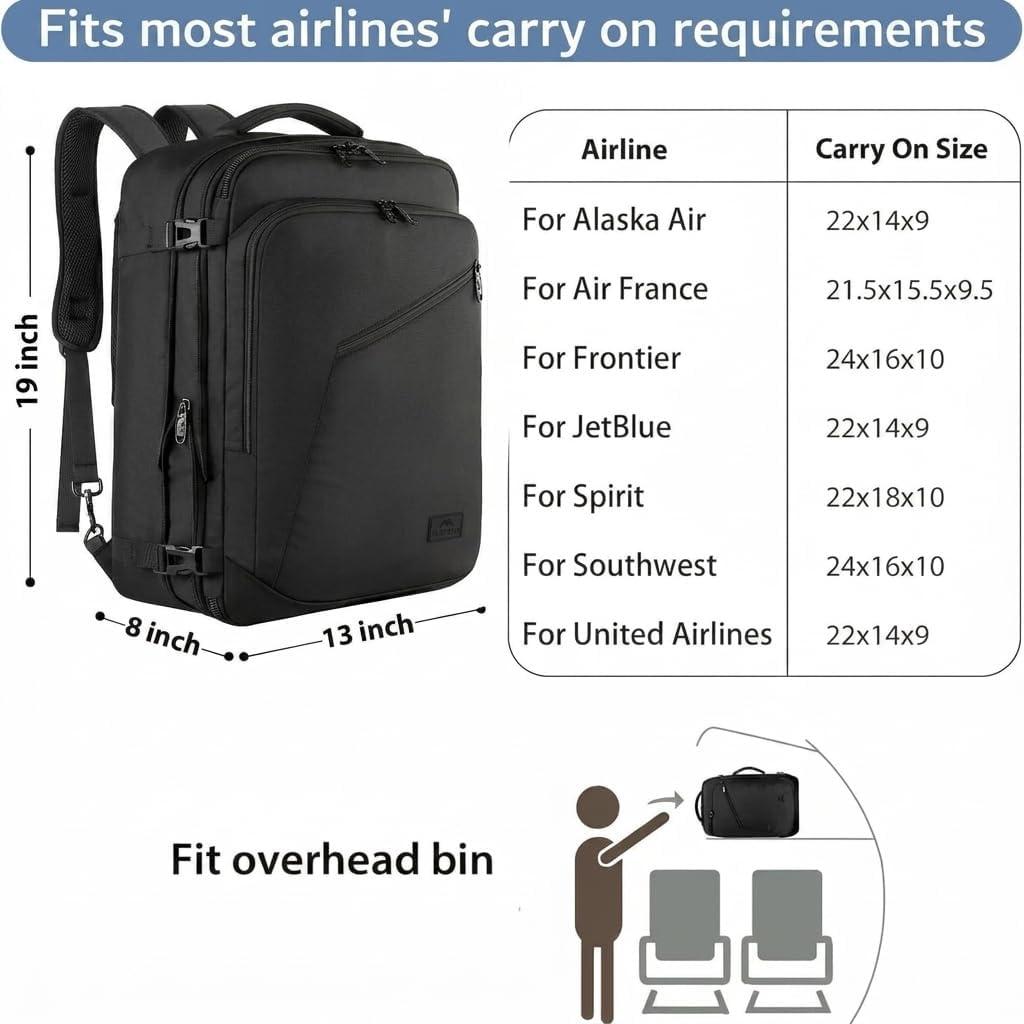
The idea behind one-bag travel is exactly what it sounds like: you bring a single backpack that fits in the overhead bin — or under the seat in front of you — and you never check luggage, never pay a bag fee, never stand at baggage claim. The backpack functions as both your carry-on and your only bag for the entire trip. Major U.S. carriers typically limit carry-on bags to around 22 × 14 × 9 inches, though enforcement varies, particularly on budget carriers. The gear decision that makes or breaks one-bag travel is the backpack itself. And here’s the genuinely surprising thing this article will walk through: based on aggregated owner reviews and published specs, a $40 or $50 bag from brands like MATEIN and SHRRADOO regularly outperforms far pricier alternatives — for specific travelers, on specific trips. That’s not a budget-friendly consolation prize. That’s the honest pattern in the data. This guide will help you figure out which side of the line you’re on.
The Core Tension: Why Budget Bags Win More Often Than You’d Expect
The default assumption in most travel gear coverage — including annual backpack roundups from Condé Nast Traveler and carry-on guides from The Points Guy — is that spending more buys you a meaningfully better experience. For frequent travelers building a long-term kit, that’s often true. But the one-bag carry-on backpack market has a genuinely unusual dynamic: the $40–$60 tier has gotten very good, very fast, and the $100–$130 mid-tier hasn’t kept pace proportionally.
Here’s what owner review data actually shows across thousands of verified purchases:
- MATEIN Travel Laptop Backpack (~$45, 40L): Owners report daily commuter plus 3–5 day trip hybrid use lasting 12–18 months without structural failure.
- SHRRADOO 50L (~$50, multi-pocket layout): One documented owner report covers 10 planes, 5 boats, and 2 trains across Southeast Asia without seam separation or zipper failure.
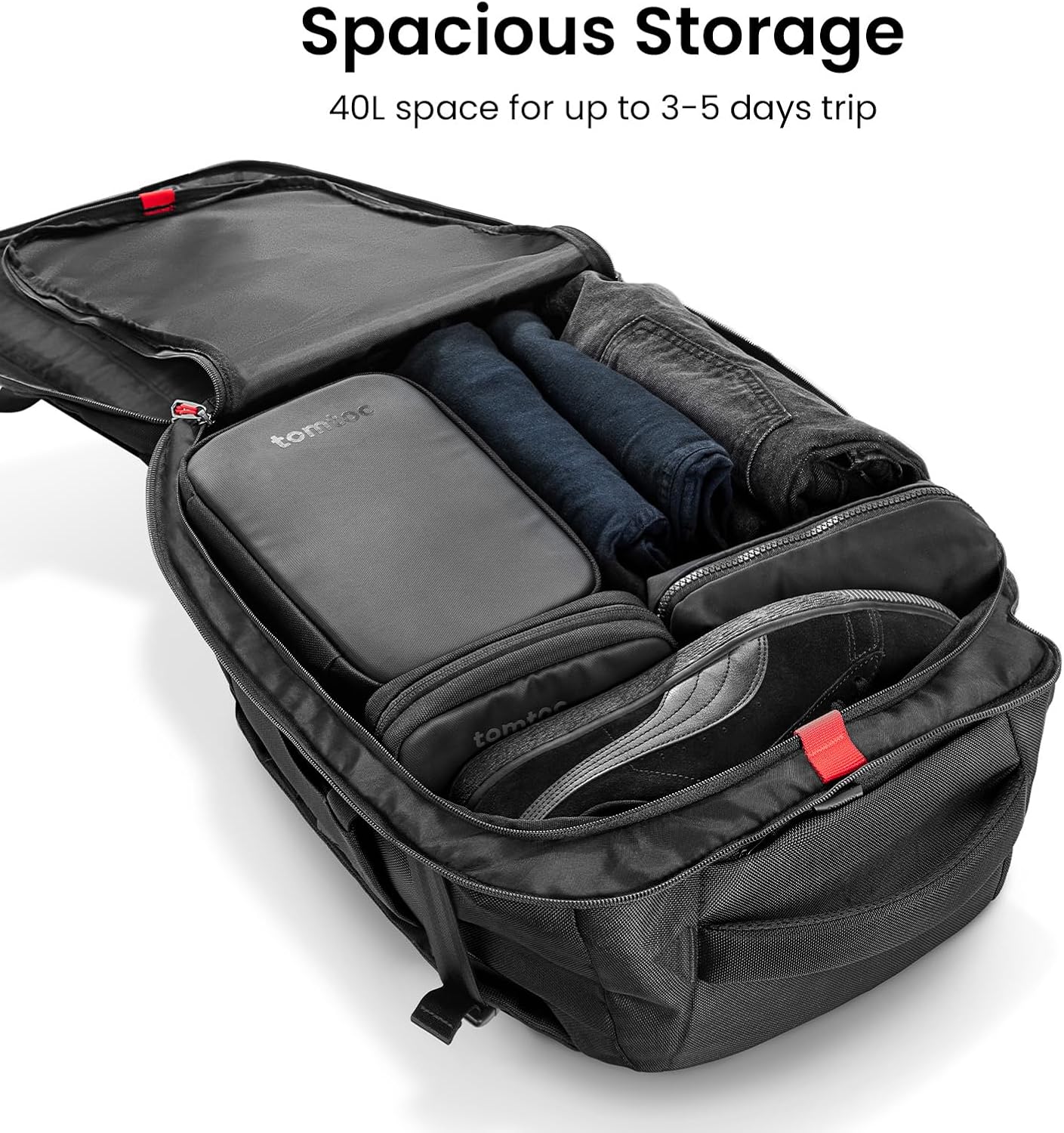
- tomtoc 40L (~$115, duffel-style opening): Consistent owner reports describe a fundamentally changed packing behavior — not just more space, but better access.
- Osprey Daylite Carry-On Travel Pack (~$130–$160 depending on configuration): Reviewers specifically cite it carrying a full day of emergency clothing and medication on an international reroute.
That Southeast Asia stress test on the SHRRADOO deserves to be taken seriously. Ten planes, five boats, two trains is not a casual vacation — that’s a multi-week circuit through environments with inconsistent baggage handling, humidity, and tight overhead storage. Owners report no zipper failures and no delamination on the shoulder straps. For the price, that’s a credible durability signal, not a fluke.
Three Bag Profiles: Where Each Tier Actually Wins
Budget Tier: MATEIN and SHRRADOO for Occasional and High-Risk Travel
There are four trip profiles where the evidence consistently favors the $40–$55 option.
Occasional travel (fewer than 6 round trips per year). REI Co-op Learn’s guide “How to Choose a Travel Backpack” notes that total-cost-of-ownership math changes dramatically based on use frequency. If you’re taking 4–6 trips a year, a bag that lasts 3–4 years at $45 costs roughly $12–15 per year. A $130 bag that lasts 8 years costs $16 per year — and the premium option only wins on cost-per-use if it actually survives significantly longer, which isn’t guaranteed in the mid-tier.
Budget airline compliance pressure. The LOVEVOOK 40L has generated a surprisingly consistent pattern in owner reports: multiple travelers specifically note it fit under the seat on budget carriers — Spirit, Frontier, and Ryanair equivalents in Europe — without being flagged for gate checking. That’s concrete compliance data. The bag’s softer structure allows it to compress into underseat dimensions that rigid or semi-rigid bags can’t match. Smarter Travel’s article “How to Pack a Carry-On Backpack for Any Trip” makes clear that soft-structure bags have a real advantage on ultra-low-cost carriers that enforce personal item limits aggressively.
Multi-mode transit where carry modes matter. Taygeer owners highlight something mid-tier bags often skip: the suitcase handle sleeve — a loop on the back panel that slides over a rolling luggage handle. On a trip moving between airport, train, and walking city segments, being able to stack your backpack on your rolling bag changes the ergonomics of your day. This isn’t glamorous, but it’s the kind of practical feature that bags priced at $80–$120 sometimes omit in favor of aesthetics.
High-risk environments. Counterintuitively, budget bags can be the smarter choice where theft risk or rough handling is elevated. If your $45 MATEIN gets stolen on a bus in Southeast Asia or soaked in a boat crossing, your total loss is $45. Owners who bring premium bags into the same environments frequently report traveling with heightened anxiety about the gear itself — which shapes behavior in ways that aren’t always positive.
MATEIN
$19.79
In stock on Amazon
Check price on AmazonMid-Tier: The tomtoc 40L for Frequent Packers Who Hate Repacking in the Dark
The tomtoc 40L’s duffel-style opening is the clearest example of a mid-tier feature that solves a real problem rather than adding spec-sheet polish. Owners don’t describe it as “more convenient” — they describe it as changing how they pack. A clamshell opening that lays flat like a duffel gives you full simultaneous visibility into the bag, which matters when you’re repacking in a hotel room at 5 a.m. or pulling out a specific item at customs.
Smarter Travel’s packing coverage specifically notes that a structured 40L with full-access opening is the benchmark for one-week carry-on travel when using packing cubes, because you can see and compress the entire interior at once. For anyone who travels frequently enough that the packing and unpacking ritual itself generates friction, the tomtoc is a genuine quality-of-life upgrade, not a marketing feature.
At $115, it’s priced at the low end of what travel publications like AFAR — in their roundup “The Best One-Bag Travel Backpacks” — and Outside Online — in “The Best Travel Backpacks, Tested” — typically consider the premium tier. But it earns that price through a single, well-executed design decision rather than a feature checklist.
Owner reports consistently suggest the tomtoc 40L fits a week’s worth of clothes for carry-on-only travel for efficient packers using packing cubes, with room for a laptop and small personal items. The wide opening is specifically what enables this — compression packing is significantly easier when you can see the full interior simultaneously.
MATEIN
$26.99
In stock on Amazon
Check price on AmazonPremium Tier: The Osprey Daylite for Frequent Flyers and Long-Horizon Ownership
The Osprey Daylite Carry-On Travel Pack addresses a different set of problems than the budget or mid-tier options, and it’s worth being specific about which travelers those problems actually affect.
The luggage handle pass-through is the most airport-specific feature in this comparison. AFAR’s travel backpack coverage and Outside Online’s gear roundups both note that airport-specific features — the ability to slide a daypack onto rolling luggage handles — disproportionately matter to frequent travelers who combine a carry-on backpack with a checked roller. Osprey owners specifically mention the pass-through in the context of medical and emergency scenarios: one documented review involves using it to carry a day’s worth of emergency clothing and medication on an international reroute caused by a missed connection. That’s not a marketing scenario. That’s a real use case.
Osprey’s All Mighty Guarantee — a lifetime repair and replacement warranty — changes the total-cost-of-ownership calculation meaningfully for high-frequency travelers. REI Co-op Learn’s overview of travel backpack selection describes the value of broad warranty coverage for bags that will absorb years of intensive use. A bag you replace once versus a bag you replace every 3–4 years at $45 starts to look different by year 6 or 7. For travelers logging 12 or more trips per year, the Osprey is the honest “buy it once” answer.
The Daylite’s laptop sleeve is functional and integrated, though owners note it takes slightly more repositioning at security compared to bags with exterior-facing laptop sleeves. For frequent travelers, this is a minor workflow note, not a dealbreaker.
tomtoc
$89.99
In stock on Amazon
Check price on AmazonThe Decision Framework: Matching Your Situation to a Choice
Rather than a ranked list, here’s the clearest way to map your situation to a decision.
If you travel 1–6 times per year and your primary concern is airline compliance on budget carriers: The MATEIN or LOVEVOOK 40L is the honest answer. Spend $40–$55, get a bag that fits, and redirect the savings toward your trip. The Points Guy’s carry-on coverage consistently notes that occasional travelers are the group most likely to overspend on gear they’ll use four times before it sits in a closet.
If you’re doing a multi-week trip through Southeast Asia, Central America, or any circuit involving mixed transit modes: The SHRRADOO 50L’s documented durability record across high-stress transit environments makes it a genuinely defensible choice, even against bags costing three times more. Budget on gear, spend on experiences.
If you travel frequently and pack and unpack in tight windows: The tomtoc 40L’s duffel opening is worth the $115. This is the bag where owners report a behavioral change in how they pack — not just a preference, a workflow shift.
If you combine a carry-on backpack with rolling luggage on longer trips, or if you need the bag to function in an airport, office, and city environment interchangeably across years of use: The Osprey Daylite’s handle pass-through and warranty terms are the premium features that pay out over a multi-year ownership horizon.
If you have a trip booked in the next 60 days and haven’t committed yet: Don’t over-optimize. Pick the MATEIN or SHRRADOO, take the trip, and use it to form opinions about what you actually wish the bag did differently. Your next bag decision will be dramatically better informed.
Frequently Asked Questions
Will the SHRRADOO 50L actually pass as a personal item on Spirit or Frontier? At 50L, the SHRRADOO exceeds what Spirit and Frontier officially allow as a personal item (typically 18 × 14 × 8 inches). Whether it gets flagged depends on how full it is, its shape when loaded, and gate agent discretion. Owners report mixed results. If personal item compliance on ultra-low-cost carriers is your specific need, the LOVEVOOK 40L’s documented underseat fit record is a better starting point. Smarter Travel’s article “How to Pack a Carry-On Backpack for Any Trip” is clear that soft-structure bags with room to compress are the safest bet for strict personal-item enforcement.
Does the MATEIN backpack hold up after months of daily use? Across aggregated owner reviews, the pattern for the MATEIN Travel Laptop Backpack is positive for commuter-plus-travel hybrid use over 12–18 months. Seam quality on the main compartment is the most commonly noted weak point after extended heavy loading. For its intended use — occasional travel plus daily commuting — the durability signal is consistently reasonable.
Which bags have a dedicated laptop compartment that’s easy to access at TSA? The MATEIN, SHRRADOO, and tomtoc 40L all include dedicated laptop compartments with exterior or near-exterior access. The MATEIN’s laptop sleeve is frequently cited in owner reviews as easy to present at TSA checkpoints without fully unpacking the bag. The tomtoc’s wide duffel-style opening means the entire bag is accessible quickly, making TSA navigation straightforward.
Is there a meaningful quality difference between a $40 and $100 travel backpack for occasional travelers? For occasional travelers (fewer than 6 trips per year), the quality difference is real but not decision-relevant for most use cases. The meaningful differences — better zippers, more refined organization, more durable strap attachment — compound over high-frequency use. For low-frequency travelers, the $40 bag is not a compromise; it’s the correct allocation of resources. REI Co-op Learn’s gear selection guidance on total-cost-of-ownership supports this framing directly.