September 4, 2026 • Maren Solley • 10 min reading time • Prices verified June 12, 2026
Large Travel Backpacks That Survive Real Trips: 40L–50L Options From $30 to $120 Tested by Owners
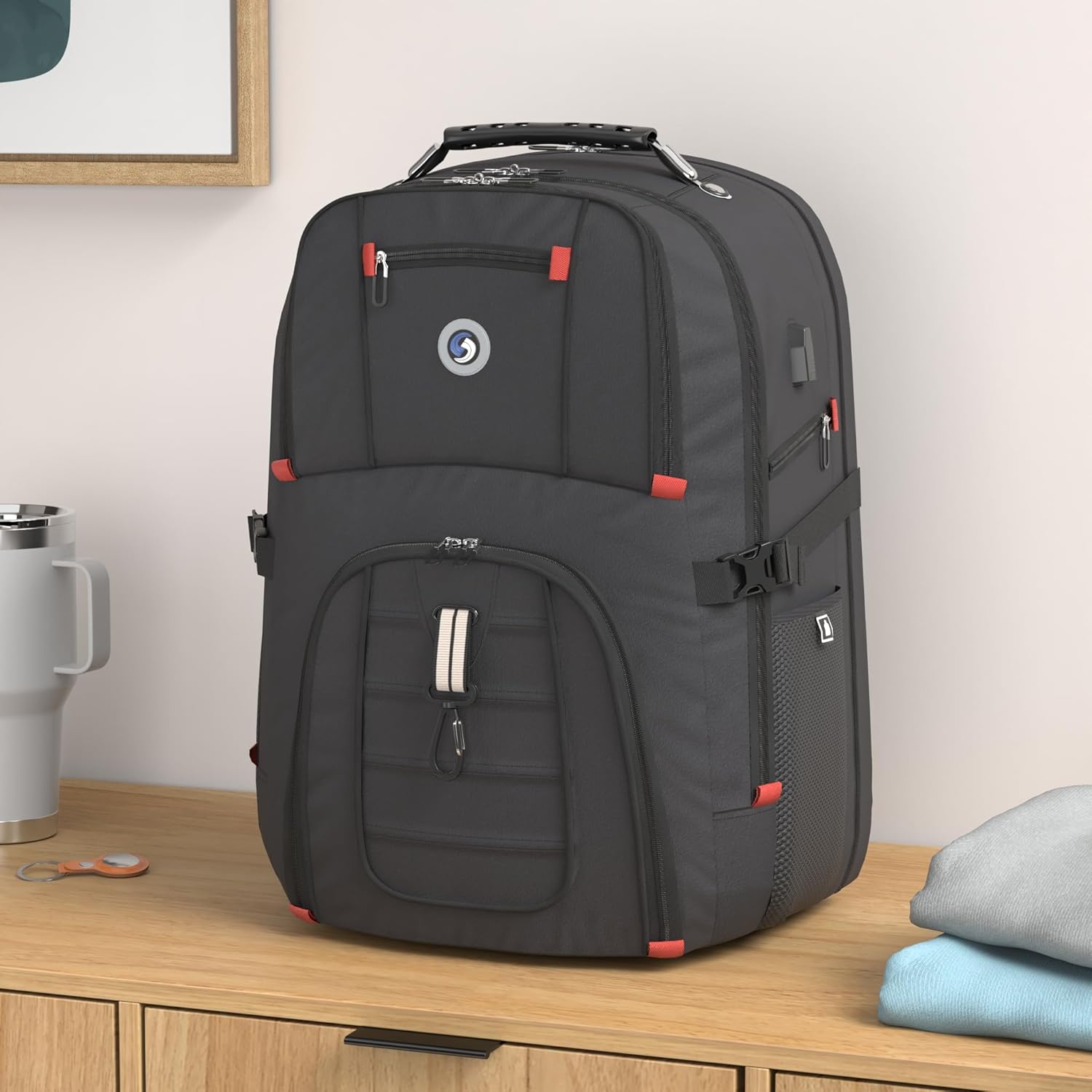
A travel backpack in the 40–50 liter range (that’s roughly the volume of three to five grocery bags stacked together) sits in a sweet spot: big enough to pack for a week or two of real travel, yet compact enough that most airlines will let you carry it onboard rather than check it into the hold. Unlike a rolling suitcase, a travel backpack distributes the load across your shoulders and hips, which matters enormously the moment you’re navigating a cobblestone street, a crowded ferry terminal, or a four-flight staircase in a budget guesthouse. This guide covers the field from around $30 to $120 — a price range where the quality gap is enormous and the owner reviews are honest in ways that premium gear marketing never is. If you’re choosing between a bag for a first two-week trip and something you’d stake a month-long overland route on, the next several hundred words will give you a clear framework.
The Budget Tier ($30–$55): What “Better Than Expected” Actually Means
Owner language matters. When aggregated reviews of the SHRRADOO 40L and the MATEIN Travel Backpack repeatedly surface phrases like “better than I expected for the price” and “I was surprised it held up,” that’s useful data — but read it carefully. Those phrases signal that buyers started with low expectations and were pleasantly cleared of the worst-case scenario. That’s not the same as confident durability.
The strongest single data point in this entire product category comes from SHRRADOO owners, one of whom documented a Southeast Asia itinerary involving 10 planes, 5 boats, and 2 trains across 3 weeks. The bag came home intact. That’s real-world stress — airport X-ray conveyors, overhead bin compression, salt air on open-deck ferries, overhead storage on regional prop planes where staff stuff bags sideways. For a bag at this price point, that outcome is genuinely notable.
There’s also a credibility signal worth naming directly: a 48-year-old teacher who reviewed the SHRRADOO specifically praised back comfort while carrying loads she described as heavy for her build. That reviewer’s experience is relevant if you’re managing back issues, traveling post-injury, or simply expect to overpack. One data point is not a guarantee — but it’s the kind of specific, attributable observation that’s more useful than a generic “comfortable straps” summary.
The MATEIN Travel Backpack performs similarly in owner reports: multiple reviewers complete multi-week trips and come home satisfied. Where the budget tier loses credibility is consistency. Individual units frequently outperform expectations; the failure rate across units is less predictable. REI Co-op’s learning center guide on travel packs notes that suspension systems and frame sheets — the internal structure that distributes load — are typically the first components to be value-engineered out at lower price points. Owners confirm this: several MATEIN reviews mention that the bag becomes uncomfortable with loads above 20–22 lbs, and that the shoulder straps compress noticeably over a 5–7 day period of continuous use.
The honest framing: budget bags in this tier carry a higher risk profile even when individual units perform well. If your trip is under two weeks, the bag is your only pack (not part of a larger luggage system), and you’re not planning to repeat this exact trip annually, the risk-reward calculus can work in your favor.
The Mid-Range Tier ($55–$90): Where Consistent Build Quality Appears
This is where the owner review language shifts. Instead of “surprised it held up,” you start reading “exactly as described” and “still going strong after X months.” The Tomtoc Travel Backpack 40L and the LOVEVOOK 50L sit in this range and are the bags that practitioners in this audience should spend the most time evaluating.
A note on opening style as a decision criterion:
Both the Tomtoc and LOVEVOOK use a clamshell opening — meaning the bag unzips on three sides and lays flat like a suitcase, rather than opening from the top like a traditional hiking pack. Reviewers across both products consistently describe this as a practical feature for mid-trip repacking: you can see everything at once, reach the bottom of the bag without unpacking the top, and repack in a compressed hotel room without upending the entire bag onto a bed. Wirecutter’s guide to travel backpacks explicitly identifies the clamshell format as the preferred configuration for travelers who are moving accommodations frequently — and owner behavior confirms this. If you’re moving every 2–3 nights, the clamshell opening is not a nice-to-have. It’s a meaningful quality-of-life difference.
The Tomtoc 40L earns consistent praise for organization depth: multiple laptop sleeves, a dedicated tablet pocket, and a front organization panel that reviewers with camera gear and digital nomad setups describe as genuinely useful rather than marketing padding. CNT’s coverage of the best travel backpacks for 2025 echoes a pattern visible in owner data: bags with named, separated compartments reduce repacking time and the cognitive load of locating items in transit.
The LOVEVOOK 50L adds meaningful capacity over the Tomtoc without a significant weight penalty according to published specs, and its duffel-style opening variant gets specific praise for hostel and guesthouse environments where floor space is limited and you need to access the bag vertically.
By the numbers — mid-range tier at a glance:
| Bag | Volume | Opening Style | Weight (published) | Price Range |
|---|---|---|---|---|
| Tomtoc Travel Backpack | 40L | Clamshell | ~1.4 kg | $65–$80 |
| LOVEVOOK Travel Backpack | 50L | Clamshell / duffel | ~1.6 kg | $60–$75 |
| Gieury Travel Backpack | 45L | Top-load + front zip | ~1.5 kg | $55–$70 |
The Gieury entry deserves a specific flag. Owners report a strap-locking failure that is worth understanding in concrete terms: the shoulder strap adjustment sliders do not hold their position reliably under load, meaning the straps gradually loosen as you walk. On a 20-minute transfer between terminals, this is a minor annoyance. On a 4-hour walking day between accommodations in a city without taxis, straps that migrate down toward your elbows become a genuine physical problem — you’re continuously re-adjusting, your load shifts toward your lower back, and fatigue accumulates faster than it should. This is the most specific and actionable criticism in this product group. If you’re planning trips with significant walking segments, the Gieury’s strap behavior is a real disqualifier regardless of its other merits.
The Upper Budget Tier ($90–$120): Structure You Can Feel
Outside Online’s roundup of the best travel backpacks notes that the $100–$120 range is where true internal frame sheets, reinforced hip-belt attachment points, and tested zipper hardware (YKK or equivalent) become standard rather than occasional. Owner reviews in this tier reflect that: the language is less “it survived” and more “it performed exactly as I needed it to.”
The Points Guy’s guide to carry-on backpacks identifies a consistent pattern at this tier: bags that have been used for 12+ months of regular travel with minimal degradation are almost exclusively from this price band or above. That observation aligns with owner data on the Osprey Farpoint 40 — widely cited by long-haul travelers as the reference standard for the 40L category. Owners with 12–18 months of use report intact zippers, no delamination, and suspension systems that hold shape. The Farpoint line’s published warranty is lifetime coverage on defects, which The Points Guy specifically calls out as a total-cost-of-ownership argument: a $110 bag that lasts five years is cheaper per trip than a $45 bag replaced every 18 months.
The “If X, Then Y” Decision Rules
This section exists because the tradeoffs above only matter if they map to your actual trip profile.
If you’re taking one trip under 3 weeks and budget is the primary constraint: The SHRRADOO 40L has the most credible durability data point in the budget tier — the Southeast Asia itinerary is a meaningful real-world signal. It’s the safest bet in the sub-$50 band. Accept that you’re buying trip-level performance, not multi-year durability.
If you’re moving accommodations every 2–3 nights on any trip of 10+ days: Prioritize a clamshell opening. The Tomtoc 40L or LOVEVOOK 50L are the clearest recommendations here. The repacking advantage compounds across days.
If you have back sensitivity or carry loads above 20 lbs consistently: Skip the budget tier entirely. The SHRRADOO teacher-reviewer data point is a positive signal, but it’s a single account. The structural differences in suspension that appear in the $90–$120 range are meaningful for this use case. The Osprey Farpoint 40 is the correct recommendation.
If you’re buying for a digital nomad setup with a laptop, tablet, and tech accessories: The Tomtoc 40L’s organization depth is purpose-built for this profile. The compartmentalization reviewers describe matches the kind of setup that involves cables, adapters, a 15” laptop, and a tablet.
If significant walking days are part of your itinerary: The Gieury strap-locking problem is a hard disqualifier. Choose anything else in this guide before accepting that failure mode.
If you’re planning to use this bag annually for multiple trips: Apply the total-cost-of-ownership lens. A bag in the $90–$120 range with a strong warranty history almost always beats two replacement cycles of a $45 bag when measured over 3–5 years. REI’s expert advice on travel packs makes this math explicit, and owner review patterns across multiple years confirm it.
Frequently Asked Questions
Can a 40L backpack genuinely replace a carry-on suitcase for a week-long trip?
Yes, reliably — but it depends on how you pack. Smarter Travel’s carry-on packing guide notes that 40L is sufficient for 7–10 days when you use compression packing cubes (which reduce apparel volume by roughly 30–40%) and plan for one or two laundry sessions. The tradeoff versus a rolling suitcase is organization depth: bags that don’t have a clamshell opening can require unpacking to access items at the bottom. For a week-long trip, this usually isn’t a problem. For 10+ days with frequent accommodation changes, the clamshell opening earns its value.
What is the real difference between an expandable 40L and a fixed 50L backpack?
An expandable 40L can theoretically reach 45–48L when the expansion zip is open, but it does so by increasing external dimensions — which can push the bag outside carry-on size limits on regional and budget carriers. A fixed 50L is optimized to a specific set of dimensions and will pack more predictably within those bounds. The Points Guy’s carry-on guide consistently warns against relying on expansion panels for airline compliance. If carry-on eligibility matters to you, fixed volume is safer.
Do budget travel backpacks under $50 actually survive multi-week trips?
Some do — the SHRRADOO’s documented Southeast Asia itinerary is real evidence of this. But “some do” is the operative phrase. The failure rate across units is higher and less predictable than in the mid-range tier. If your trip is once-off and cost matters most, a budget bag is a reasonable gamble. If you’re equipping yourself for regular travel, the consistency risk is not worth the savings.
How important is the clamshell opening versus a top-load design for travel?
For travelers moving frequently between accommodations, it’s significant. Wirecutter’s travel backpack review specifically identifies clamshell access as the preferred format for city-to-city travel because it eliminates the need to excavate the bag to find items. Top-load designs are better optimized for hiking, where you load once and don’t access the main compartment until you make camp.
Will a 50L backpack fit in an overhead bin or does it always get gate-checked?
It depends on the carrier and the bag’s dimensions, not just the volume. SeatGuru and The Points Guy both document that major U.S. carriers allow overhead bins up to approximately 45 linear inches (length + width + height combined), while budget and regional carriers enforce smaller limits. A 50L bag that measures within those dimensions will usually fit. A 50L bag that is wide or deep beyond those limits will not. Check the published dimensions of any specific bag against the carrier’s size policy before booking.
Are the shoulder straps on these bags adequate for long walking days between hotels?
At the budget tier, not reliably. Owner reviews for bags under $50 frequently mention strap compression after several days of continuous use. Mid-range and upper-tier bags with padded, structured straps perform significantly better. The Gieury strap-locking issue described above is a specific failure mode — strap slippage under load — that’s distinct from general comfort. For walking days over 3–4 hours, spending up into the $90–$120 tier is a straightforward tradeoff worth making.