September 7, 2026 • Maren Solley • 8 min reading time • Prices verified June 12, 2026
Compression Packing Cubes That Cut Real Weight From Your Carry-On
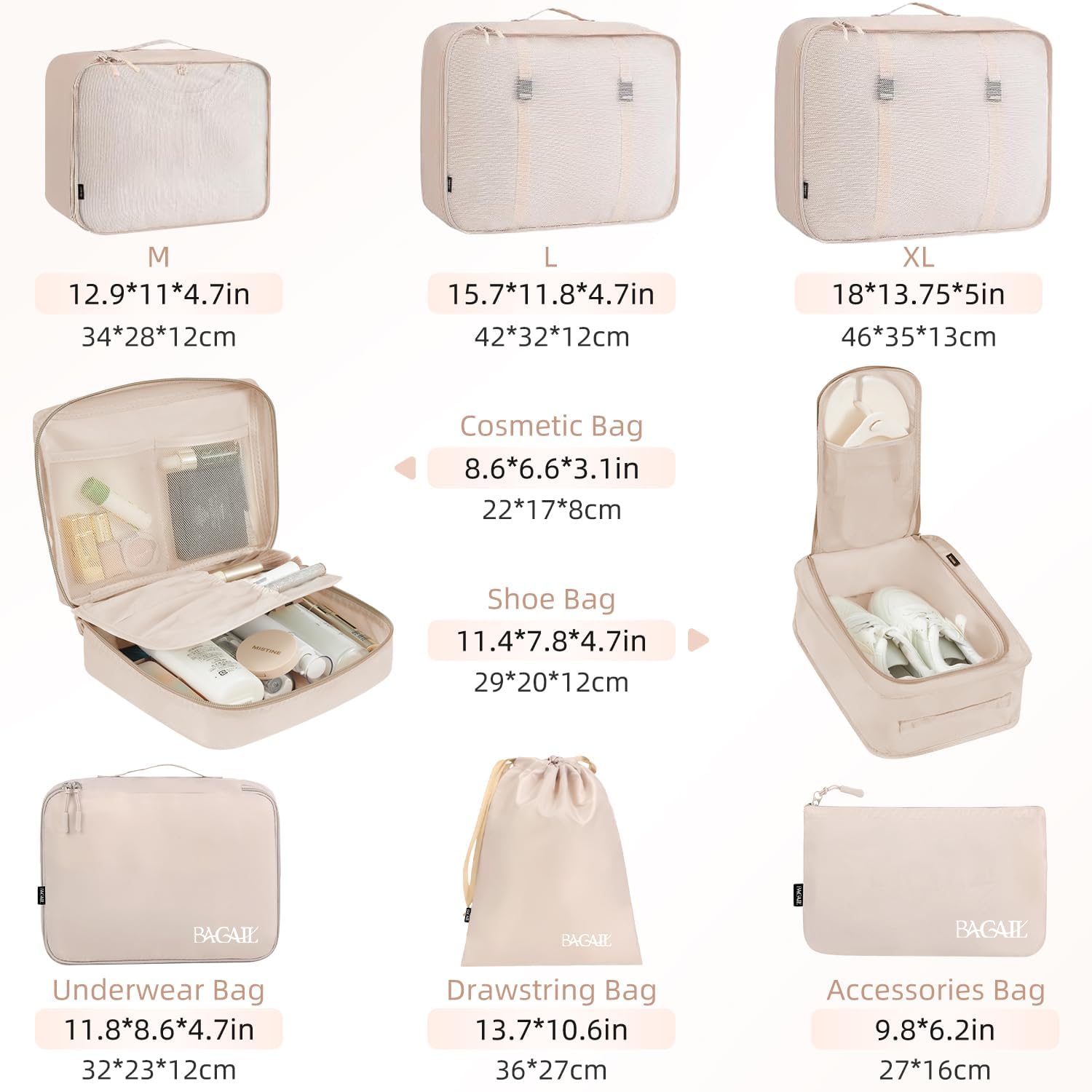
If you’ve ever arrived at the gate only to have a gate agent eyeball your bag and ask you to overhead-bin it — or watched your carry-on swell uncomfortably against its own zipper — you already understand the problem. Packing cubes are fabric organizer pouches that fit inside your suitcase or backpack and keep clothing grouped and tidy. Compression packing cubes add a second zipper that, when closed, squashes the contents down by forcing air out of the fabric stack — reducing total volume without reducing what you’ve packed. That distinction matters: you’re not leaving anything at home, you’re just taking up less space. This guide explains how much volume (and real bag weight) compression cubes can actually recover, names the tradeoffs worth knowing, and gives you a clear decision framework so you can stop second-guessing the category and start packing smarter.
| EDITOR'S PICKCompression Packing Cubes for T… | Mid-tierAmazon Essentials 4-Piece Packi… | Budget pickBAGAIL 8 Set Packing Cubes Lugg… | |
|---|---|---|---|
| Pieces | 6 | 4 | 8 |
| Mesh top | — | ✓ | — |
| Double zipper | — | ✓ | — |
| Color | Grey & Orange | Gray | Cream |
| Price | $49.95 | $18.89 | $16.99 |
| See on Amazon → | See on Amazon → | See on Amazon → |
What “Compression” Actually Does — and What It Doesn’t
Let’s be precise, because the marketing language on compression cubes is genuinely muddled.
Volume compression is real. Weight compression is not. The clothes inside a cube weigh exactly the same whether you compress them or not. What compression does is reduce the volume those clothes occupy, which gives you two practical benefits:
- You reclaim bag space, which either lets you pack more items or lets you downsize to a smaller (lighter) bag.
- Your bag stays under size limits, which avoids checked-bag fees or gate-check hassle.
The second benefit is where the real weight savings come from — indirectly. If compression lets you fit a week’s worth of clothing into a 40-liter backpack instead of a 55-liter one, you’ve swapped a heavier bag chassis for a lighter one. That’s a legitimate weight reduction of 300–800 grams depending on the bags compared, even though the cubes themselves added some weight back.
Smarter Travel’s carry-on packing guide puts it plainly: compression cubes are a volume management tool first, and their weight benefits are downstream of that volume gain. Keep that framing in your head when you’re comparing options.
How Much Volume Do Compression Cubes Actually Save?
Published specs vary, but the general range you’ll see across mainstream brands is a 30–60% volume reduction on a stuffed cube when the compression zip is fully closed. Soft fabrics — t-shirts, underwear, thin athletic layers — compress more. Jeans, fleece, and knit sweaters compress less; they’re denser and their fibers resist full deflation.
REI’s packing cubes buying guide notes that compression cubes perform best with “softer, flatter garments” and that travelers packing heavier mid-layers should have realistic expectations about achievable compression ratios.
By the numbers:
| Fabric type | Typical compression gain | Notes |
|---|---|---|
| T-shirts / underwear / athletic wear | 45–60% volume reduction | Best use case; fabric collapses cleanly |
| Button-down shirts (rolled) | 30–40% | Works well; minor wrinkle tradeoff |
| Jeans / denim | 10–20% | Denim is dense; minimal gain |
| Fleece / mid-layers | 15–25% | Fibers trap air; don’t compress fully |
The Weight Cost of the Cubes Themselves
This is the tradeoff most guides gloss over, and it’s worth naming directly: compression cubes are heavier than regular packing cubes. The second zipper, the reinforced zipper track, and the slightly stiffer fabric panels all add up.
Across published spec sheets, a typical compression packing cube in a medium size (roughly 10L) runs 100–180 grams. A standard non-compression packing cube in a comparable size runs 40–90 grams. You’re adding 60–100 grams per cube just by choosing compression.
If you’re running three compression cubes (a sensible setup for a week-long trip: one for tops, one for bottoms, one for underlayers), you’ve added roughly 180–300 grams of cube weight to your pack before a single item of clothing goes in.
Whether that’s worth it depends on a simple equation: does the volume compression let you carry a meaningfully lighter bag chassis? If you were already planning to use a 30L daypack and compression gets you from “can’t quite close it” to “comfortable fit,” you’ve justified the extra cube weight many times over. If you’re already packing light and not bumping against size limits, standard lightweight cubes may serve you better.
Wirecutter’s long-running packing cubes review makes a similar observation — that for ultralight travelers already under bag weight limits, the overhead of heavy-duty compression cubes may outweigh the organizational gain.
Comparing the Main Options: Where Published Specs and Owner Reports Diverge
Three products consistently dominate conversations in this category as of mid-2026: the Eagle Creek Pack-It Reveal Compression Cube Set, the Peak Design Packing Cube system, and the Osprey Ultralight Compression Packing Cube. Here’s how they stack up on the dimensions that matter.
Eagle Creek Pack-It Reveal Compression Cubes
Eagle Creek’s Reveal line is the volume leader in this category, and their published specs show why: the medium cube (11L uncompressed) compresses down to roughly 6L — a reduction the spec sheet puts at about 45%. Owners in aggregated long-run reviews consistently call the double-zip mechanism reliable over repeated use, though several note that the zipper track requires a firm, even pull to seat properly. At roughly 110–130 grams per medium cube, they’re on the lighter end of the compression category.
The Reveal line also carries Eagle Creek’s lifetime warranty — a meaningful cost-of-ownership factor if you’re buying into a packing system you plan to use for years.
Peak Design Packing Cubes
Peak Design’s cubes are a different philosophy: they’re designed to function as a packing system within a larger Peak Design bag ecosystem, using a top-loading clamshell format rather than the traditional dual-zip compression approach. Published specs rate their compression at a more modest 25–30%, but owners consistently report that the structured format keeps clothing better organized and easier to access mid-trip than squeeze-to-compress alternatives. They run heavier — the medium cube is spec’d at around 150–170 grams — and more expensive (roughly $60–75 per cube as of May 2026).
AFAR’s packing cubes roundup notes that Peak Design’s cubes suit travelers who reprioritize organization and accessibility over maximum compression.
Osprey Ultralight Compression Packing Cube
Osprey’s entry is the weight-optimizer’s choice in this category. Published specs put the medium size at around 75–90 grams, which is notably lighter than either competitor above. The compression ratio is spec’d at roughly 35–40% — not the maximum in the class, but meaningful. The tradeoff owners report most consistently is zipper durability: the lighter chassis uses a thinner zipper tape, and reviews at Condé Nast Traveler’s roundup flag that it shows wear faster under heavy compression use than Eagle Creek’s track.
If you’re optimizing for total system weight and compression is a “nice to have” rather than a “need to maximize,” the Osprey is worth serious consideration.
When Compression Cubes Are Worth It (and When They Aren’t)
Here’s the decision framework, stated plainly.
Use compression cubes if:
- You’re packing a carry-on at or near your target airline’s maximum linear dimensions or weight limit, and volume is the binding constraint.
- You’re transitioning from a larger bag to a smaller one (e.g., from a 40L to a 26L daypack-as-carry-on) and need to make the math work.
- You pack primarily soft, compressible fabrics — athletic wear, t-shirts, thin base layers — where compression ratios hold up.
- You’re a long-haul traveler or digital nomad doing multiple back-to-back trips where the organizational consistency of a stable cube system saves you repack time.
Skip compression cubes (use standard lightweight cubes instead) if:
- You’re already packing well under your bag’s volume and weight limits. The added cube weight works against you.
- Your wardrobe is dominated by denim, structured blazers, or thick knit sweaters. Compression will be marginal and the zipper stress is high.
- You’re running an ultralight kit where every gram is accounted for — a 90-gram non-compression mesh cube does real work at half the weight.
- Budget is a hard constraint: compression cubes run $30–75 each versus $10–25 for standard cubes, and the savings don’t justify themselves if you’re not near a volume limit.
Total Cost of Ownership: The Calculation Most Buyers Skip
Premium compression cubes cost $120–250 for a three-cube set (May 2026 pricing across major retailers). That sounds steep against a $25 budget alternative. But run the math over a realistic use horizon.
If you travel 15+ times a year — a threshold many location-independent professionals and frequent business travelers cross easily — a set of well-built compression cubes gets used 15 times in year one and probably 50+ times over a three-year span. At $180 for a quality set with a lifetime warranty, you’re at roughly $3.60 per trip. Budget alternatives at $30 for a set that fails after 18 months of heavy compression stress cost you more per trip and more in replacement friction.
The Eagle Creek lifetime warranty is the clearest expression of this math: you pay once, send it in when a zipper fails, and get it repaired or replaced. That’s the kind of backstop that changes the cost-of-ownership calculation for serious travelers.
The Decision Rule
If you’re sitting with a specific trip or bag decision in front of you, here’s the clean if/then:
- If you’re bumping against your carry-on’s volume limit and packing mostly soft fabrics → buy a compression cube set. Eagle Creek Reveal is the durable default; Osprey Ultralight if you’re weight-obsessed and willing to monitor the zipper.
- If you’re not volume-constrained → standard lightweight cubes are the smarter buy. Spend the difference on a better bag or a spare power bank.
- If you’re building a long-term travel system → factor the warranty and replacement cost before dismissing the premium price. Eagle Creek’s coverage changes the math over a 3–5 year horizon.
- If your kit is heavy fleece or denim → compression cubes won’t move the needle. Rethink the wardrobe before buying the cube.
The core insight: compression cubes are a leverage tool, not a magic solution. Used at the right moment in your packing equation, they’re one of the higher-return investments in travel gear. Used when you’re already packing light, they’re just added weight you’re hauling around the world.