August 28, 2026 • Maren Solley • 11 min reading time • Prices verified June 12, 2026
Camera Backpacks That Double as Travel Carry-Ons: Do They Actually Work?
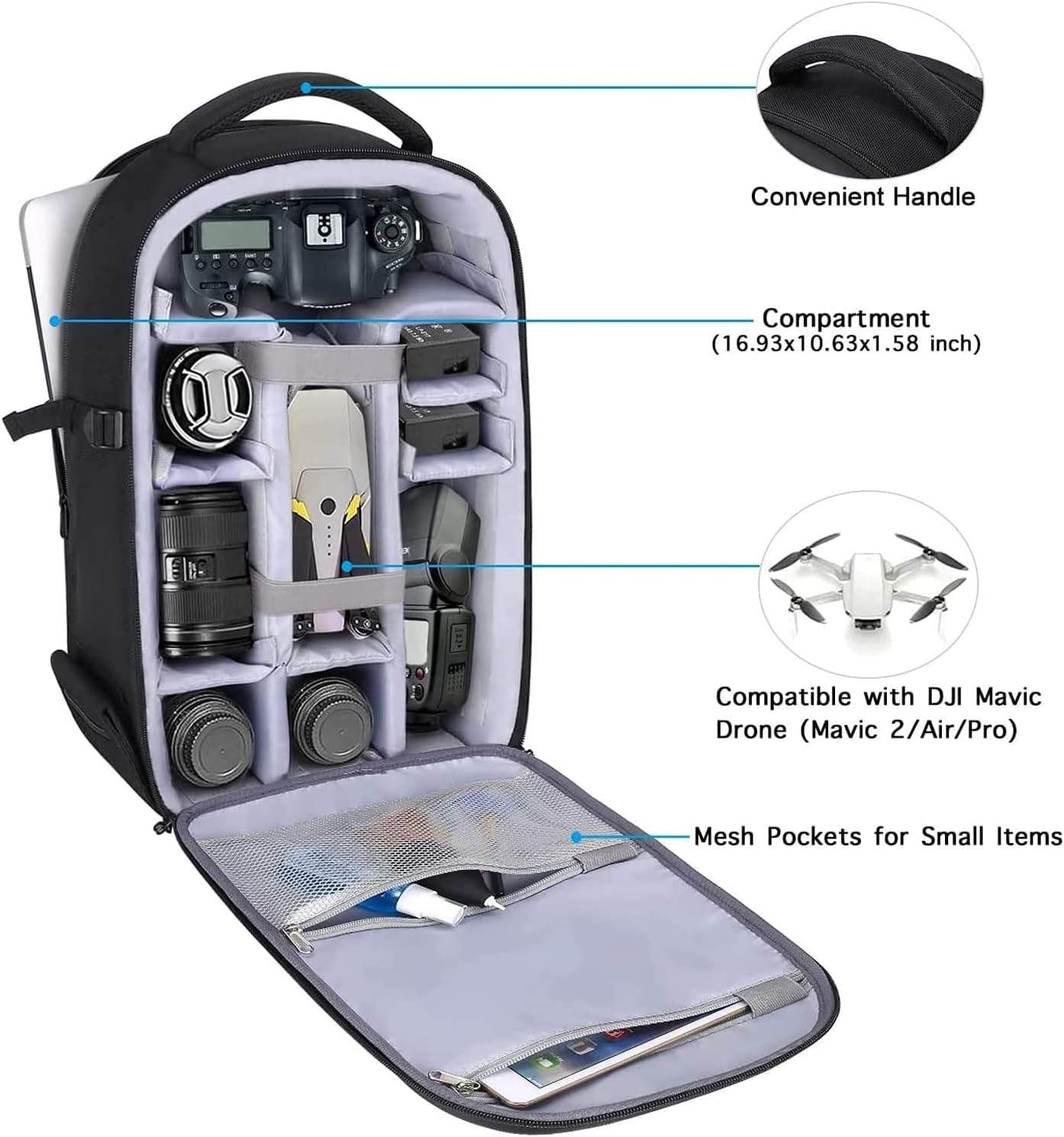
A camera backpack is a padded, compartmentalized bag purpose-built to protect cameras, lenses, and accessories from bumps and dust. A travel carry-on is a bag small enough to fit in an airplane’s overhead bin (typically no larger than 22 × 14 × 9 inches on most U.S. carriers) so you never have to check luggage. The dream is combining both into a single bag: one well-designed pack that holds your camera kit and your clothes and laptop, clears airline size limits, and keeps your gear safe from the moment you leave home. It’s a genuinely appealing idea — one bag, one overhead bin slot, no checked-luggage fees, no waiting at baggage claim. But the dream has real constraints, and the honest answer to “do they actually work?” is: sometimes, and only if you pick the right bag for your specific kit. This guide breaks down the mechanics, the tradeoffs, and the bags where the dual-use case holds up.
| EDITOR'S PICKtomtoc Travel Backpack 40L | Mid-tierMOSISO Camera Backpack | Budget pickMATEIN Travel Laptop Backpack | |
|---|---|---|---|
| Capacity | 40L | — | — |
| Fits laptop | 17.3 in | 15–16 in | 15.6 in |
| TSA carry-on | ✓ | — | — |
| Tripod holder | — | ✓ | — |
| Price | $89.99 | $51.18 | $19.79 |
| See on Amazon → | See on Amazon → | See on Amazon → |
The Core Tension: Camera Bags and Carry-On Rules Are Pulling in Different Directions
Camera protection requires volume and structure. Proper padded dividers — the removable foam or fabric walls that let you configure compartments around lenses and bodies — take up meaningful space. A system that safely cradles two mirrorless bodies and a mid-range zoom typically needs 20–30 liters of dedicated camera space before you add a laptop sleeve, a change of clothes, or a toiletry bag.
Airline carry-on limits, meanwhile, are tightening, not loosening. Per SmarterTravel’s updated 2025 carry-on size guide, major U.S. carriers have held relatively steady at 22 × 14 × 9 inches for overhead bags, but budget carriers in Europe and Southeast Asia have moved aggressively toward smaller personal-item-only policies — and enforcement, historically inconsistent, has grown more rigorous at gates as planes fill closer to capacity. AFAR Media’s 2025 carry-on rules overview notes that the days of reliably squeezing an oversized bag overhead are largely over on high-load routes.
So the tradeoff is structural: every inch you allocate to padded camera protection is an inch you’re taking from clothing and everyday carry. The bags that solve this best are not “camera bags that happen to fit clothes” — they’re more precisely modular systems where the camera section is removable or compressible, letting you reclaim volume when you’re traveling light on gear.
How the Main Contenders Actually Stack Up
The MOSISO Camera Backpack is one of the most discussed options in this category. Owners consistently report that the bag feels more premium than comparable Lowepro soft-side packs — better stitching, more satisfying zipper pulls, a denser padded exterior that reads more like a serious travel bag than a camera-store accessory. The standout data point from verified owner reviews: one owner documented fitting two Panasonic G9 Mark II bodies, a 100–400mm zoom, and a CPAP machine alongside a laptop — a genuinely impressive load that speaks to how deep the main compartment runs. Reviewers also note “secret pockets” (interior slip pockets behind the camera section, and a rear flat pocket that sits flush against the back panel) as a practical favorite for passports and quick-access items.
What owners don’t report: this is a soft-side bag with padded dividers, not a hardshell. The “hardshell” language occasionally attached to this bag in informal reviews refers to a semi-rigid outer panel on the camera section, not a clamshell exterior. That distinction matters for lens protection — more on that in the FAQ below.
The MATEIN Travel Camera Backpack has a longer owner track record in the dual-use category. Multiple reviewers specifically note they’ve been using it as their only travel backpack since 2020 — carrying camera gear alongside daily electronics, which is exactly the use case this guide is evaluating. What’s notable in MATEIN’s reviews is how often owners describe the bag not as a camera bag with extras, but as a travel backpack with organized camera storage. That framing difference is meaningful: the camera section is cleanly separated from the main travel compartment, which means you can pack clothes in the back and gear in the front without everything mixing.
The tomtoc 40L Travel Backpack shows up in a different kind of review. Owners who mention camera gear in their feedback aren’t primarily photographers — they’re general travelers who happen to carry a mirrorless body or a compact system and want it protected alongside their other kit. Reviewers specifically mention packing camera gear as part of their kit for trips like Hawaii-to-Sedona routes. The tomtoc’s 40L capacity gives it genuine luggage-replacement credentials, and its structure accommodates an improvised camera setup (a padded pouch inside the main compartment, for instance) without the bag being explicitly built around that use case.
By the Numbers
| Bag | Stated Capacity | Camera Section | Laptop Sleeve | Typical Street Weight |
|---|---|---|---|---|
| MOSISO Camera Backpack | ~30L | Dedicated, padded dividers | Yes (up to 17”) | ~1.8 lbs |
| MATEIN Travel Camera Backpack | ~35L | Dedicated, removable | Yes (up to 15.6”) | ~2.0 lbs |
| tomtoc 40L Travel Backpack | 40L | Integrated sleeve / improvised | Yes (up to 16”) | ~2.4 lbs |
The Protection Gap Nobody’s Talking About
Here is the honest gap in how these bags are actually used: reviewers who reach for general travel backpacks and pack camera gear into them almost never mention padded dividers or lens-specific protection. They’re improvising — tucking a mirrorless body into a packing cube, wrapping a lens in a fleece, or relying on a separate padded insert that they bought independently.
This isn’t a catastrophic problem for most mirrorless shooters. A Sony A7 series body in a padded packing cube in the main compartment of a 40L travel pack is not in serious danger from normal travel handling. But it’s a long way from the systematic protection a dedicated camera bag provides. If you’re traveling with a fragile zoom in the 100–400mm range, or prime lenses with delicate front elements, improvised padding is a real risk on turbulent flights or routes with aggressive bag handling.
The Wirecutter’s camera bag coverage (The New York Times, updated 2025) draws this line clearly: padded divider systems from dedicated camera bags — the kind where each lens has its own foam-lined cell — provide meaningfully better drop protection than aftermarket inserts dropped into a general travel pack. The insert market (Peak Design, F-Stop, Shimoda sell dedicated inserts) partially bridges this gap, but adds cost and weight.
The practical decision rule: if your lens kit includes anything you’d be devastated to replace — a GM lens, a luxury telephoto, a cinema prime — a bag with proper integrated dividers is worth the volume tradeoff. If you’re traveling with a kit you could rebuild for under $1,500, the improvised approach is defensible.
What Frequent Travelers Are Actually Doing
Across aggregated owner feedback, the pattern that emerges among frequent travelers who use camera backpacks as carry-ons is not “find the perfect single bag” — it’s “optimize for the trip type.”
For a weekend city break or a 3–5 day destination trip: a 30L dedicated camera backpack like the MOSISO works cleanly. The camera section handles the kit, the remaining volume handles two days of clothing and a toiletry bag, and the laptop sleeve handles work. The bag clears standard U.S. carry-on dimensions with room to spare when not overpacked.
For a longer trip (7–14 days, multiple destinations): the tomtoc 40L or a similar high-capacity travel pack with an aftermarket insert becomes more practical. You reclaim volume for more clothing and recover it for the camera section when you need it.
For expedition-level travel or multi-month overland routes: the dual-use question largely dissolves. At that trip length, serious photographers typically carry a dedicated camera bag as a personal item and a separate travel backpack for everything else — two bags, two bin slots, which works on most carriers.
Condé Nast Traveler’s 2025 best travel backpacks coverage makes a relevant point: the best single-bag solution for most travelers is a bag designed from the start with both use cases in mind, not a bag retrofitted for one purpose or the other. That’s the real case for evaluating the MOSISO and MATEIN specifically, rather than simply dropping an insert into the tomtoc and calling it solved.
Frequently Asked Questions
Will a camera backpack fit in an airline overhead bin without being gate-checked?
For most U.S. and major international carriers, yes — if the bag is within 22 × 14 × 9 inches unstuffed. The risk zone is at maximum load: padded camera dividers and loaded gear can push outer dimensions out past nominal limits. Owners of the MOSISO and MATEIN consistently report clearing overhead bins on domestic U.S. flights and major European carriers. Budget carriers in Europe (Ryanair, Wizz Air) are a different situation — check their specific size cages before flying, as their personal-item policies are stricter and actively enforced.
Can I carry a full-frame camera kit plus a laptop and clothes in one bag without exceeding carry-on weight limits?
This is where the math gets tight. A full-frame body plus two or three lenses can run 4–6 lbs before you add the bag’s tare weight (roughly 2 lbs), a laptop (4–6 lbs), and clothing. U.S. domestic carriers generally don’t enforce carry-on weight limits, but international carriers — particularly in Europe, Asia, and the Middle East — often cap carry-on weight at 7–10 kg (15–22 lbs). At a loaded weight of 20+ lbs, you’re over on many carriers. Mirrorless systems — Sony A7 series, Fujifilm X-T5, OM System OM-5 — materially help here; a mirrorless kit with two lenses often comes in 2–3 lbs lighter than an equivalent DSLR setup.
Does the MOSISO hardshell actually protect lenses better than padded-divider soft bags?
The MOSISO’s semi-rigid camera section provides better bump resistance than a purely soft bag, but it’s not a true hardshell in the sense of a Peli/Nanuk case. Owners report the rigid back panel on the camera section absorbs side impacts better than comparable Lowepro soft packs. For most travel scenarios — overhead bin loading, normal ground handling — it’s adequate. For checked luggage or routes with heavy bag-toss handling, a proper hard case with foam insert is still the safer standard.
Is it worth buying a dedicated camera travel bag if I only travel with a mirrorless camera a few times a year?
Probably not for protection alone. At fewer than five trips per year with a mirrorless kit, a padded insert inside a bag you already own — or a compact padded pouch — is a reasonable starting point. The case for a dedicated camera travel bag gets stronger when you factor in organization: the ability to access your camera quickly at the top of the bag, the peace of mind during overhead bin loading, and the cleaner separation between camera gear and clothing. If you’re still deliberating, the MATEIN’s price-to-feature ratio makes it a lower-stakes first dedicated bag than the Lowepro Pro Trekker line.
How do I stop a camera-loaded backpack from tipping forward on my back?
Camera weight in the lower-front section of a bag (where most camera compartments live) creates a forward pull. The mechanical fix is load placement: heavier items (bodies, larger lenses) should sit as close to your spine and as high in the camera section as the divider layout allows. Owners of the MOSISO consistently note the back panel’s lumbar padding helps offset this, but the deeper structural fix is a sternum strap — if the bag you’re evaluating doesn’t have one, that’s a genuine comfort shortcoming on trips longer than a few hours.
The Decision Rule
If you’re traveling with a mirrorless kit (1–2 bodies, 2–3 lenses) on trips of 3–7 days and you want one bag in the overhead bin: the MOSISO or MATEIN is the right category, and either justifies its price over improvised solutions within a handful of trips in avoided checked-bag fees alone.
If you’re traveling with a full-frame DSLR or a heavy telephoto zoom for trips beyond a week: plan for two bags or a checked hold-all. The single-bag fantasy is admirable but the physics don’t cooperate.
If you only carry a camera occasionally and your primary need is a great travel backpack: the tomtoc 40L handles the camera use case acceptably with the right insert, and the extra volume makes it the stronger long-trip performer.
The bags that genuinely work as dual-use carry-ons are not compromises — they’re just designed for a specific traveler and a specific kit. Know your kit weight, check your route’s carry-on limits, and the decision practically makes itself.