August 8, 2026 • Maren Solley • 9 min reading time • Prices verified June 12, 2026
Carry-On Backpacks That Actually Pass the Airline Size Check
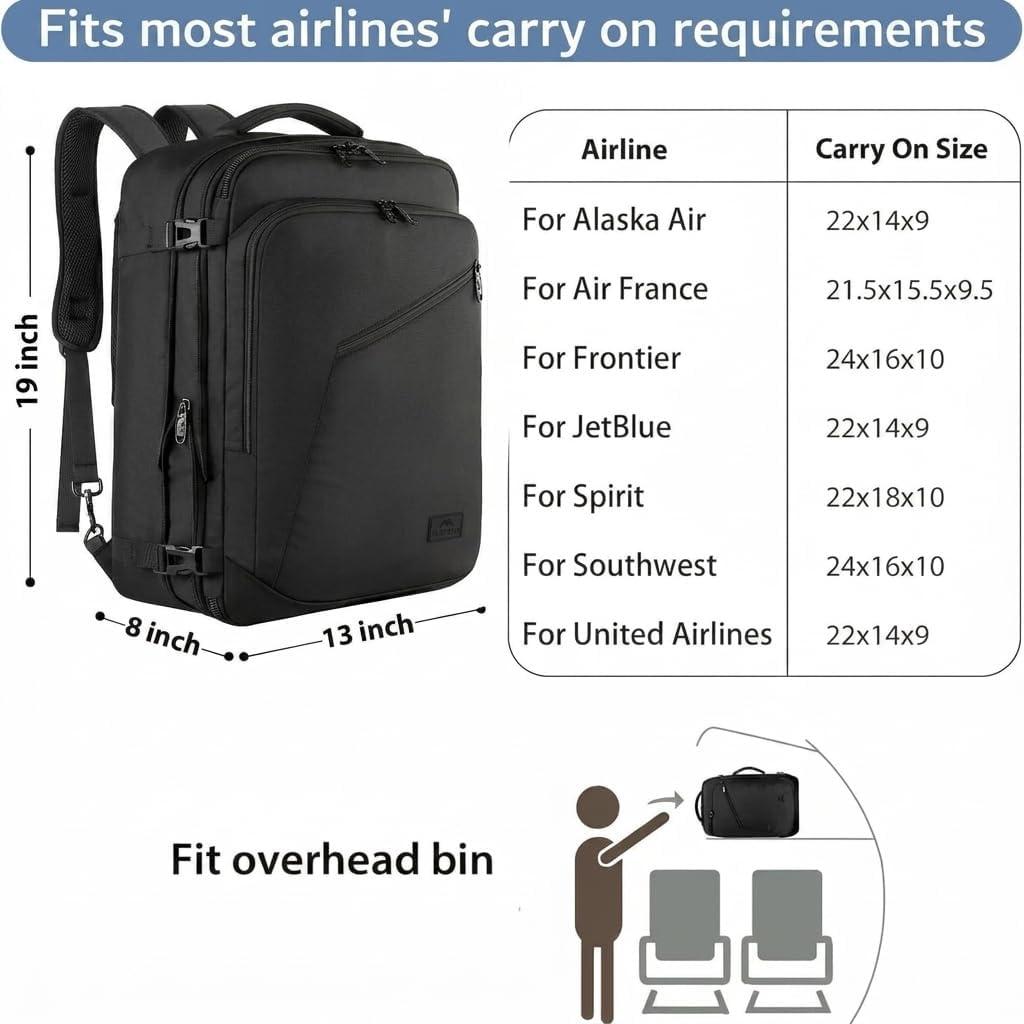
If you’ve ever hustled to the gate with a backpack you were confident would fit overhead, only to watch a gate agent hold up the metal sizing bin and wave you over, you already understand the stakes. A carry-on backpack — meaning a backpack large enough to serve as your one main bag on a flight, replacing a rolling suitcase — should fit in the overhead compartment without a checked-bag fee. The problem is that “fits” means different things to different airlines, and a bag marketed as “airline-approved” may be sized for one carrier’s rules while technically busting the limit on another’s. This guide cuts through that confusion. By the end, you’ll know exactly which dimensions to shop against, which bags consistently clear real-world gate checks across a broad range of carriers, and how to make the final call between the top contenders at every price point.
| EDITOR'S PICKOsprey Daylite Expandable 26+6… | Mid-tierECOHUB Travel Backpack 18x14x8… | Budget pickMATEIN Carry on Backpack | |
|---|---|---|---|
| Capacity | 26L (expand 32L) | — | 40L |
| Expandable | ✓ | — | ✓ |
| Airline size | — | 18x14x8 in | — |
| Pockets | — | 13 | — |
| Water resistant | — | ✓ | ✓ |
| Price | $110.00 | $32.99 | $26.99 |
| See on Amazon → | See on Amazon → | See on Amazon → |
Why “Airline-Approved” Is Marketing, Not a Guarantee
No single universal standard governs carry-on dimensions across all airlines. The International Air Transport Association (IATA) has proposed a voluntary guideline — 55 × 35 × 20 cm (roughly 21.7 × 13.8 × 7.9 in) — but as IATA’s own Cabin Baggage Standards documentation notes, adoption by individual carriers remains optional. Most major full-service carriers set their own limits, and those limits vary meaningfully.
The Points Guy’s carrier-by-carrier breakdown (updated through 2025) illustrates the spread: Delta and United allow up to 22 × 14 × 9 in (roughly 56 × 36 × 23 cm), while Ryanair and easyJet — Europe’s two largest low-cost carriers by passenger volume — hold the line at 40 × 20 × 25 cm for the cabin bag included in a basic fare. Spirit and Frontier in North America have some of the tightest enforcement reputations on the continent.
The practical implication: a bag that sails through every Delta flight can get gate-checked on a Ryanair leg without a seat-upgrade fare. If your itinerary mixes carrier types — full-service transatlantic plus a low-cost intra-Europe hop, for example — you have to size against the most restrictive carrier in the routing, not the most permissive.
By the Numbers: A Quick Reference
| Carrier type | Typical max linear dimensions | Typical volume ceiling |
|---|---|---|
| Major US full-service (Delta, United, AA) | 22 × 14 × 9 in / 56 × 36 × 23 cm | ~45 L |
| European full-service (Lufthansa, BA) | 55 × 35 × 20 cm | ~38 L |
| European LCC basic fare (Ryanair, easyJet) | 40 × 20 × 25 cm | ~20 L |
| Asian full-service (ANA, Singapore) | 55 × 40 × 25 cm | ~55 L |
Dimensions represent published maximums as of 2025; always verify against the carrier’s current booking conditions before travel.
The Spec-Sheet Trap: Why Published Bag Dimensions Lie
Here’s where experienced travelers still get caught: a bag’s published dimensions are almost always measured empty, panels relaxed, with compression straps loose. Load the same bag to its rated volume, and the packed dimensions can exceed the empty spec by 2–4 cm on the depth axis alone — exactly the dimension most sizing bins test hardest.
Smarter Travel’s reporting on carry-on enforcement trends notes that gate agents are increasingly directed to check the packed bag, not an empty shell, particularly on high-load short-haul routes where overhead space runs out fastest. A bag that measures 20 cm deep when empty may balloon to 24 cm when packed to even 60% capacity if it lacks internal compression or a structured rear panel.
What to look for instead:
- External compression straps that cinch the bag’s depth, not just its height. Side compression is common; what matters is whether straps run front-to-back across the main compartment.
- A semi-rigid or structured back panel that prevents the bag from bulging rearward when loaded.
- A clamshell or panel-loading layout (where the main compartment opens flat like a suitcase) rather than a top-loading barrel design — clamshells pack to a more consistent depth because you’re loading flat layers, not stuffing down.
- Published packed dimensions where the manufacturer provides them. Very few do; when they do, it’s a signal of honest engineering.
Condé Nast Traveler’s 2025 travel backpack roundup specifically flags this distinction, noting that bags with welded or molded frames hold their shape under load better than frameless designs and produce fewer surprises at the gate.
The Top Contenders, Sized Honestly
Osprey Farpoint 40 — The Reliable All-Rounder
Published dimensions: 53 × 34 × 25 cm | Volume: 40 L | Weight: ~1.4 kg
The Farpoint 40 has accumulated years of real-world data, and the pattern across aggregated reviews is consistent: it passes the overhead test on US full-service carriers without drama and clears most European full-service allowances. The 25 cm depth is right at the published limit for several European carriers, which is the one genuine risk. Osprey’s integrated LTS (Liftoff Travel System) back panel stows behind a zippered flap so the bag presents as a standard piece of luggage rather than a technical backpack at the check-in counter — a meaningful advantage when agents are in a gate-check mood.
Owners consistently report that the front-load clamshell layout and internal compression straps keep the bag to its published depth even when packed close to capacity. At roughly $160–$180 at REI and similar outdoor retailers, it remains the most defensible recommendation for a first serious travel backpack.
The tradeoff: At 40 L it’s right at the ceiling. If your routing includes a Ryanair or easyJet basic-fare leg, you’ll need to either upgrade your fare class to include a cabin bag or accept the gate-check fee.
Tortuga Setout 35 — Built Specifically for the Size Problem
Published dimensions: 53 × 35 × 20 cm | Volume: 35 L | Weight: ~1.5 kg
Tortuga designed the Setout explicitly around airline carry-on compliance, and the 20 cm depth spec shows that intentionality. The IATA guideline depth — the dimension most often checked — is 20 cm, and Tortuga hit it. Outside Online’s 2025 carry-on backpack coverage calls it one of the few bags in its size class with a genuinely honest depth spec under load, a rarity.
The panel-loading layout is among the best executed in the category: the main compartment opens completely flat, the laptop sleeve is padded and suspended, and the organization panel on the lid is more refined than most bags at this price (~$250–$290). The tradeoff is comfort under heavy loads — the harness system is serviceable but less ergonomic than Osprey’s for anything approaching a full day of hiking in city.
Best for: Travelers with mixed itineraries involving European LCCs, or anyone who wants maximum rule-compliance margin built in.
Tom Bihn Synik 30 — The Premium Compact Option
Published dimensions: 48 × 33 × 20 cm | Volume: 30 L | Weight: ~0.9 kg
At 30 L the Synik 30 gives up usable capacity relative to the 35–40 L field, but it earns that trade with near-universal gate compliance across every carrier tier. Tom Bihn’s published specs have a strong reputation for accuracy — the company is unusually transparent about how it measures, per multiple long-form reviews in the travel community — and the 20 cm depth holds under load because of a structured internal architecture and the absence of external frame sheet flex.
The Synik sits at $325 direct from Tom Bihn, which positions it at the premium end for a bag this size. Owners in long-run reviews consistently note the organization system — multiple internal pockets with a logical hierarchy — as genuinely differentiating for carry-on-only travel where you can’t rummage through a checked bag.
The tradeoff: 30 L is tight for trips longer than five to seven days unless you’re a disciplined packer or doing laundry every few days. Location-independent professionals who work primarily from one or two cities tend to rate it highly; extended overland travelers often find they’ve outgrown it within a trip.
Aer Travel Pack 3 — For the Tech-Heavy Traveler
Published dimensions: 55 × 35 × 22 cm | Volume: 35 L | Weight: ~1.6 kg
The Aer Travel Pack 3 is purpose-built for digital nomads and business travelers who carry a full tech stack — laptop, tablet, cables, adapters, power banks — alongside clothing. The dedicated tech organization panel is the most complete in the category at this price ($230–$260), with a full-length laptop compartment, a separate tablet sleeve, and cable routing that reviewers consistently flag as the bag’s defining feature.
The 22 cm depth puts it in the same risk zone as the Farpoint 40 for strict European carrier enforcement, but the structured back panel keeps it honest. The Points Guy’s gear coverage notes the Travel Pack 3 as a consistent recommendation for frequent business travelers on US-dominated routes, with the caveat that European LCC legs warrant either a fare upgrade or a second look at a depth-optimized bag.
The Decision Framework: If X, Then Y
You’ve seen the tradeoffs. Here’s how to close the decision:
If your routing is primarily US domestic or transatlantic on major carriers (Delta, United, AA, BA, Lufthansa): The Osprey Farpoint 40 is the correct call. Maximum usable volume, proven compliance, well-understood harness system, and a price that doesn’t require justification.
If your routing includes European LCC legs on a basic fare (Ryanair, easyJet, Wizz Air): Size against their published cabin-bag limits. That means the Tortuga Setout 35 or Tom Bihn Synik 30 — both hit 20 cm depth. If you’re unwilling to sacrifice volume, price the fare upgrade for a larger cabin bag allowance: on many routes it costs less than one gate-check fee.
If you carry significant tech hardware and travel primarily on US/Asian full-service routes: The Aer Travel Pack 3’s organization system justifies its slightly looser depth spec in that context.
If you’re a frequent long-haul traveler who needs maximum compliance across mixed-carrier itineraries and is willing to pay for it: The Tom Bihn Synik 30’s combination of honest specs, durability reputation, and lifetime warranty support makes it the lowest-friction long-term choice, even at the capacity sacrifice.
One final rule that applies across all of the above: always check the current published dimensions on your carrier’s website before the trip, not a third-party summary. Airlines update baggage policies without fanfare, and a rule that held last year may have tightened on this year’s booking. The five minutes it takes to verify is the cheapest insurance in travel gear.